
Quick Summary
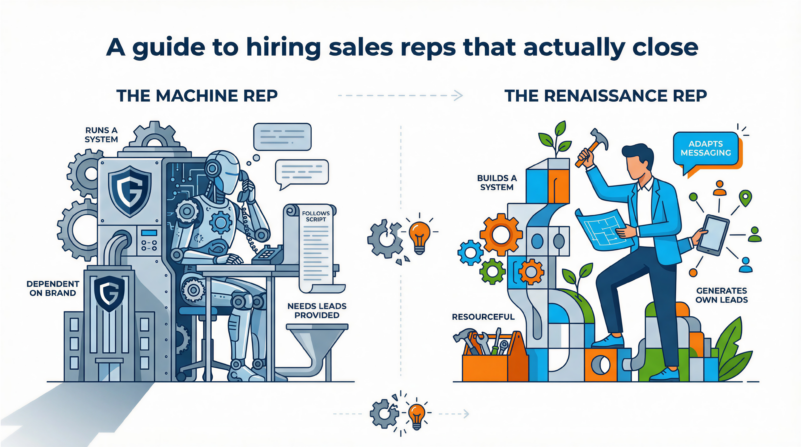
Stop hiring shiny enterprise reps to build your startup sales engine. You don’t need someone who can run a machine, you need someone who can build one.
Takeaways
-
Hiring from big logos is lazy thinking, what matters is whether they’ve built pipeline without the machine behind them.
-
In an early-stage business you are hiring for creation, not just closing, so test for resourcefulness, writing, and strategic thinking.
-
Run real assessments, make them sell your product, rank target accounts, and write cold outreach, don’t rely on polished war stories.
-
If they cannot generate momentum, tighten process, and thrive in ambiguity within 30 days, act fast and fix it.
I watched a founder spend six months, two recruitment agencies, and north of £50,000 hiring a sales rep from Salesforce. Impressive CV. Knew all the right acronyms. Had a LinkedIn profile that read like a trophy cabinet.
He lasted eleven weeks.
The problem wasn’t that he was bad at sales. He was almost certainly very good at sales – inside a machine with serious brand pull, SDRs feeding him leads, and a marketing engine stacking his diary with meetings. Take away that scaffolding and drop him into a startup where the CRM is half-built and nobody has heard of your company? He drowned.
Too often, founders hire the wrong profile for the job that actually exists inside their business. The job in a scale-up is not the job in a big company. The market is different. The support is different. The sales process is different. Even sales leaders who’ve thrived in enterprise machines can fail fast in this world.
To avoid these costly mistakes, define the sales roles you actually need, assess candidates for resourcefulness, and make sure your onboarding matches your company’s stage.
It’s about making sure they answer the right question. Rather than asking yourself “where have they worked?” I prefer to consider “what have they actually done, without the machine?”
Of course, before you even contact a recruitment agent, you need to assess whether it’s the right time to bring a salesperson into the team, or whether you’re setting them up to fail before they’ve even been shown where the kettle is.
Forget the logo. Hire the renaissance rep.
There’s a specific type of talent that thrives in a growing business. They look nothing like what a first time founder assumes they should look like. I call them the “renaissance rep.”
A renaissance rep is a generalist: adaptable, curious, and genuinely energised by building the sales process rather than just running it. They don’t need the playbook handed to them. They want to help write it.
Many sales professionals are brilliant inside a defined system – territory, SDR team, recognised brand, steady demand, clear pricing. They’re successful in that environment. Some are the best salespeople you’ll ever meet.
But your organisation is not that environment. Not in the early days.
In a startup, the job includes creating demand, shaping messaging, feeding back what you’re hearing from customers, and tightening the process every week. That requires a different kind of ability and temperament. It also requires real support from you as CEO, because you’re still close to the product and close to the market, and you’re still the person who can unblock things fast.
This is where founders get seduced by logos. A shiny brand on a CV feels like certainty. It feels like the safe choice. It feels like you’re buying security.
Often, you’re doing the opposite.
Behind plenty of failed sales hires is a simple mismatch: you hired someone trained to run a machine, then asked them to build one. That isn’t fair on them, and it isn’t fair on your business… Ultimately, don’t hire the logo. Hire the person who’s built in the dark.
If you’re hiring your first salesperson, you’re not just hiring for closing. You’re hiring for creation. You’re hiring for someone who can talk to strangers, turn them into prospects, turn prospects into first conversations, and keep going through the awkward bits until there’s something repeatable. In other words: you’re hiring the person who helps founder-led sales become a team sport.
The flip side of that is that hiring a salesperson doesn’t mean you get out of sales altogether. It just stops you having to do it all.
The “harder product” test (and why it works)
Here’s a shortcut that saves time in the hiring process.
When you look at someone’s background, ask one question: was their last product harder to sell than mine?
Not “more complex.” Not “more features.” Harder to sell.
If they sold for a challenger in a competitive market – where they had to fight for attention, earn trust, and create belief – they’ve got the right muscle memory. If they sold for the market leader where the brand did most of the heavy lifting, be cautious.
It’s like identifying a good goalkeeper for your football team. You want someone who’s played behind a leaky defence and still performed – someone who’s faced their fair share of pressure without a defence in front of them. Not someone whose stats look great because they barely faced a shot.
When I say “harder to sell,” I mean the real work of early sales:
- They generated their own leads, not just worked inbound.
- They earned their own first meetings, not just turned up to a warm diary.
- They refined messaging with real customers, not just repeated the official script.
- They tried other ways to create pipeline when the obvious route failed.
- They created momentum without a famous brand opening doors.
If a candidate has never done that, it doesn’t mean they’re a bad salesperson. It means they’re the wrong salesperson for this job right now. And if you’re the CEO, don’t let your ego get involved. This isn’t about “good” or “bad.” It’s about fit.
Don’t hire “a rep.” Hire an experiment.
If you hire one rep and it doesn’t work, you’re left guessing. Was it the person? Was it the product? Was it your onboarding process? You learn nothing. You’re just six months poorer.
If you can afford it, hire in pairs. Two sales hires close together creates a natural experiment. Healthy competition. Shared learning. And most important of all – data.
If both struggle, the issue is bigger than the hire. If one succeeds and the other doesn’t, you learn what success looks like in your context. The hiring process still has to be tight. But if cashflow allows, it’s a smarter use of money than hiring one person, waiting six months, then repeating the cycle.
Don’t think that simply bringing in two salespeople makes your life easier, however. You still need to focus on selection, onboarding, and explicit 30/60/90-day expectations. One bad hire can cost you a year. Two bad hires can cost you even more.
The interview that actually tells you something
Most sales interviews are like a greatest hits album. The candidate underlines their career highlights. The founder nods. Everyone leaves feeling good.
But that’s not going to get you the results you need. Here’s a different way to approach a sales interview.
Make them sell your product back to you. Give them 48 hours and access to whatever you have: website, pitch deck, any YouTube videos, any demo environment you can share. Then run a single session: 10-minute pitch, 10 minutes of discovery questions, 10 minutes of objection handling.
You’ll see it straight away. Can they learn fast? Can they structure a sales conversation? Can they stay confident when challenged? Can they present effectively and demonstrate the ability to communicate value to clients and stakeholders?
Test their strategic thinking. If you want a rep who can create a pipeline, test it. Don’t just ask “have you done outbound?” – everyone will say yes. Give them 100 target accounts in your market and ask them for 10 data points they would use to rank them.
The right salespeople will spot signals, prioritise effort, and be able to build a plan that turns leads into real meeting outcomes. They’ll notice things like “they recently hired a new Director of Ops” or “They’re using a competitor of ours but the contract runs out in Q3.” This is the difference between someone who can do what they’re told, and someone who can figure out what needs to be done.
Test their writing. Modern sales is written as much as it’s spoken. Cold messages. Follow-ups. Post-meeting summaries. If someone can’t write clearly, their selling becomes messy fast. Ask for a three-sentence cold email to a target account. You’d be amazed how many candidates fail this.
The written screen: Your fastest filter
Before you even get to interviews, add a written screen. A Google Doc, three or four biographical questions. Ask things like:
- Tell me about a time you built pipeline from scratch. What did you do in week one?
- Tell me about a deal you nearly lost. What changed it?
- What do you do when you’ve had a terrible week and nothing is landing?
- What’s a sales process you’ve improved, and how did you improve it?
Firstly, this approach filters for effort – people who won’t spend 20 minutes writing thoughtful answers are not serious. Secondly, it filters for narrative skill. Strong sales professionals can tell a clear story. Weaker candidates hide behind buzzwords.
It also shows attitude. Passion for the product or the industry matters. The candidates who show real enthusiasm and motivation are the ones who’ll join the company, stick around, and become successful members of your team.
You can train skills. You can build process. You can develop product knowledge. But you can’t coach someone into enjoying ambiguity. And in a startup, ambiguity is the job.
What you’re really hiring for: The four Hs
Forget the CV for a moment. Your first sales hires come down to four essential traits.
Hunger. A genuine need to win. Not greed – competitive drive. The desire to be good at the craft.
Hustle. Willingness to do unglamorous work: prospecting, follow-up, repetition. If you need someone to create leads and book first conversations from scratch, hustle matters more than polish.
Humility. The ability to learn and adapt. Startups change constantly: messaging, pricing, product, market. Humble people flex. Rigid people snap.
Heart. Resilience. The capacity to take a run of rejection without losing energy. Early sales is a lot of “no.” You want someone whose response is curiosity, not defeat.
This is why the renaissance rep wins. They’re built for change, not comfort. They eventually become your most successful sales leaders not because they had the best CV, but because they built something real.
Red flags to look out for
Walk away from candidates who lead with money before they ask about the product. You want builders, not people optimised for comfort.
Walk away if they can’t show evidence of building pipeline. Ask directly: what did you do when there was nothing in the funnel and no inbound leads? If they look blank, they’ve never done it.
Be cautious of anyone chasing a manager title before they’ve proved they can sell. People using management as an escape from carrying a number are a risk at this stage.
And watch out for candidates who’ve only ever worked at brand names. A logo is not a skill. It’s access to a machine. When that machine disappears, you find out what they can actually do.
The 30-day verdict
You’ll usually know within a month whether a hire is going to work – not from closed revenue, but from leading indicators.
The signals are obvious. Are they asking questions constantly, or just nodding along? Are they generating activity, or “still getting up to speed”? Have they gone on a listening tour across the business—product, delivery, customer success—so they understand what you actually do and why customers buy? Or are they sitting back waiting for someone to hand them a script and a list?
Great sales hires are conspicuously curious from day one. They become students of the product immediately. They should be able to talk about the value simply, run a credible first call, and handle basic objections without falling apart. If they can’t get there fast, they’re not the right person for this job.
You should also see evidence of creation. Not vague “activity”. Real effort that turns into pipeline: targeted outreach, improving messaging, trying other ways to reach accounts rather than hoping inbound will save them. And you should see them making the sales process less fragile – capturing what they’re learning, tightening the talk track, documenting what works.
And if they are not the right person, fire fast. Keeping a poor performer for “fairness” is not fair to anyone. It burns cash, damages morale, and wastes months you cannot afford to lose. Sometimes a poor hire reflects a poor hiring process. Sometimes it’s simply the wrong person. Either way, act.
Your onboarding is part of the hiring process
Founders love to blame the hire. Sometimes it is the hire. Sometimes it’s the founder..
If you hire a renaissance rep and give them no support, no target list, no product deep dive, and no time with you as CEO, you’ve set them up to fail. Your onboarding doesn’t need to be perfect, but it certainly needs to exist.
Give them: clear access to the product and the people who built it; top customer stories that explain why customers buy; common objections and your best responses; your current sales process (even if it’s rough); and a clear activity plan for the first month covering leads, outreach, and first meeting goals.
Choose an onboarding strategy that fits your stage – there’s no one-size-fits-all. If you’re trying to move from founder-led sales to a team-owned motion, onboarding is the bridge. Do it properly and you move faster. Do it badly and you stall.
Slope over intercept
Finally, one last filter.
When evaluating candidates, look for trajectory over current status. A person promoted quickly at a growing startup is often a better bet than someone who’s sat comfortably in the same role for years at a larger company.
Look at their CV for evidence of relevant experience and success in similar environments – but don’t let the CV do all the talking. Review it for patterns: did this person choose harder paths? Did they participate in building something, or just run something already built?
Look for the talent who chose the harder path because it meant growth. Look for the person who still wants to join a startup and build something real in the world; someone willing to participate in the messy early work that eventually becomes the success story.
That’s the renaissance rep.
The point
In a scale-up, the first sales reps aren’t just there to close deals. They’re there to help you build a sales process that works without you – creating leads, winning meetings, learning the market, refining the message, and turning messy effort into something repeatable.
If you hire someone trained only to run a machine, you’ll spend months watching them look for a machine that doesn’t exist. So look at your current candidates. Are you hiring someone who can build – or someone who needs the brand and the machine to function? Make that decision well and you’ll build a sales team that can scale. Make it badly and you’ll burn time, burn money, and end up doing the job all by yourself again.
Every hiring decision shapes your company’s future. Invest the time to get it right.