
Quick Summary
Start treating your time like a finite resource, not a public park. A VA won’t fix a failing product, but they will stop you wasting your best hours on expensive nonsense.
Takeaways
-
A VA cannot rescue a broken business model or a rubbish product, but they can stop you from starving your strategy of the attention it actually needs.
-
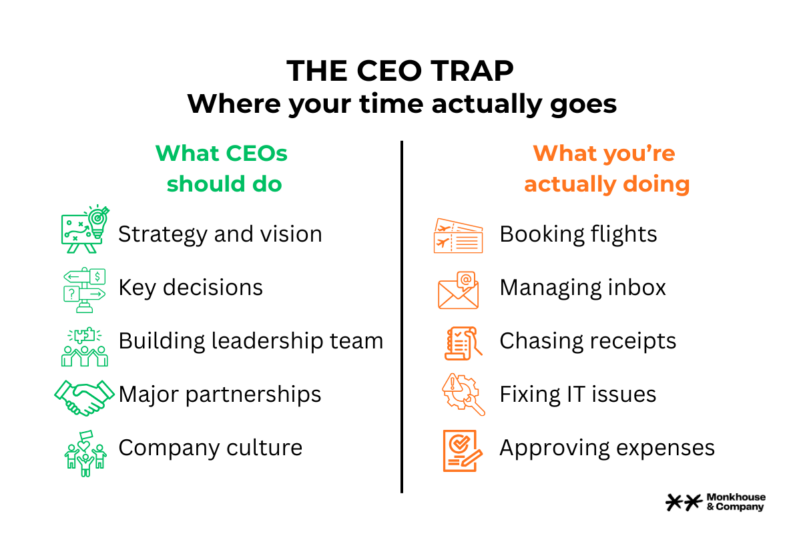
If you are still booking your own flights and triaging your own inbox, you are not acting like a leader, you are just a very expensive admin.
-
Delegation fails because you provide vague tasks instead of clear outcomes, turning a potential asset into just another person you have to micromanage.
-
True leverage comes from offloading repeatable, rules-based work so you can stop living in the shallow end of your own business.
Are virtual assistants the secret weapon of startups?
Probably not.
If you’re hoping a VA is going to swoop in and fix things while you sip flat whites and “think strategically”, I’ve got bad news. A VA won’t rescue a sh*t product. They won’t fix weak positioning. They won’t stop your sales pipeline being held together by hope and your one lucky customer from 2023.
But they can stop you wasting your best hours on absolute nonsense. And that’s the bit that really matters. Because startups don’t usually die from lack of cash. They die from attention starvation. Yours. You get burned on “urgent” work that doesn’t move anything.
From the outside, it looks like leadership. You’re “across it”. Always available. Inside? You’re the central nervous system. Everything routes through your memory, your inbox, your last-minute check-in, your “just send it to me and I’ll have a look”.
At first it’s flattering. Then it’s limiting. Then it’s lethal. Not because you’re rubbish, but because you’re doing too much of the wrong stuff. And if you’re in that 50-100 staff zone, this becomes obvious quickly. Your day turns into tiny decisions, silly interruptions, “quick” calls, inbox triage, chasing people, booking things. You end the day knackered… and nothing important changed.
You look busy. But nothing’s moving.
Colour-coded calendars, ten comms channels nobody reads, a shared digital workspace that’s so complicated you need a week’s training before you can add anything to it. It feels productive. You’re “on it”. You’re “across everything”. But a lot of it is admin theatre – motion without progress.
Founders are particularly vulnerable because you can always justify it. “Customers need me.” “If I don’t do this, it won’t get done.” Sometimes that’s true. Most of the time, it’s habit mixed with a tiny addiction to being needed. The result? Your best thinking gets shoved into scraps. Strategic thinking is saved up for “when it calms down”. Big decisions get delayed because your diary is full of other people’s priorities.
Founder-dependence doesn’t arrive with a dramatic crash. It creeps in like rising damp. You can be busy all day and still not move the business forward. Follow-up gets patchy. Hiring gets delayed. Systems never get built because you’re always reacting.
The real cost isn’t admin. It’s context switching.
You’re trying to lead, sell, hire and think… while bouncing between scheduling, chasing invoices, pointless threads, and “I’ll just do it quickly.” Your brain never gets into gear. You live in the shallow end. That’s why a VA is useful: it reduces the drag. Not by being “brilliant”. By stopping you doing daft things with your day. And yes, I’ll say it plainly: if you’re still booking your own flights or managing your calendar, you’re not acting like the CEO – you’re an overpaid admin.
Buy flexibility, not more overheads
Full-time hires lock you into costs, roles and expectations long before the business has stabilised. A VA is flexible by design: you can scale hours up or down, buy specific skills when you need them (support during a launch, marketing ops for a quarter, finance clean-up before fundraising), then dial it back when your requirements drop. That flexibility matters, because it turns fixed cost into something you can actually control. Simple. Sensible. Undramatic. Effective.
What a VA actually changes day-to-day
The biggest benefit of a VA isn’t “support”. It’s that they stop you doing stupid things with your day. The classic founder day: you start with good intentions, a couple of big priorities, maybe even proper deep work. Then your inbox pulls you in. A meeting gets moved. A customer email triggers panic. You chase an invoice, book travel, reply to threads that didn’t need you, “quickly” check your email and lose 40 minutes.
By 4pm, you’ve been busy all day and achieved nothing you’ll remember by tomorrow, let alone next month.
A VA breaks that loop by taking the repeatable, rules-based, low-risk tasks off your plate so your brain isn’t constantly switching contexts. And the impact is bigger than it sounds, because context switching doesn’t just waste time – it wrecks quality. Your big decisions get made in the gaps. Your strategic thinking happens when you’re tired. You start living in the shallow end of your own business. A VA helps you climb out.
The smart way to delegate
Most founders try to delegate the complicated stuff first because it’s the stuff they hate. Bad move. Start with work that is repeatable, rules-based, easy to check, and low risk if it’s 80% right.
Diary management
If your calendar is a public park, you’re finished. Your assistant should block focus time, stop back-to-back meeting carnage, protect lunch, and batch calls instead of scattering them.
Inbox triage
Don’t worry, you’re not outsourcing your personality, you’re outsourcing sorting. They filter noise, flag what matters, draft simple replies, and route requests.
Follow-ups
The quiet killer of sales momentum. A VA can keep your pipeline moving with nudges, bookings, confirmations, chasing “just one more thing” so deals don’t die.
Logistics
Travel, bookings, receipts, expenses – all things that really do not deserve (or need) your attention. Your assistant can book everything, manage changes, chase confirmations, and keep on top of receipts/expenses so you’re not donating an afternoon to Ryanair admin and a crumpled VAT receipt.
Meeting hygiene
An assistant can get agendas written, make sure pre-reads go out, capture actions, and stop meetings happening “because we always do that one”.
Light ops admin
Invoice chasing, CRM tidy-up, updating docs, compiling weekly numbers – all of that belongs with an assistant if it’s defined properly.
Why most VA setups fail (and how to not mess it up)
When founders say “VAs don’t work”, what they mean is: “I hired someone and gave them vague tasks with no context, no outcomes, and no decision framework… and it didn’t magically turn into leverage.”
A VA relationship fails for boring reasons. You delegate tasks, not outcomes. “Sort my inbox” is a task. “Make sure I only see emails that need my input, and draft replies for the rest using these rules” is an outcome. You don’t define what they can decide, so they interrupt you constantly. Then you say they’re not proactive — but they’re being cautious because you haven’t given them a sandbox. You don’t build a system, you build another dependency. If everything runs through WhatsApp and ad hoc voice notes, you’ve just created a second inbox. The fix isn’t complicated. It’s just grown-up.
The simplest operating rhythm that actually works
You don’t need a big process. You need just enough structure so delegation doesn’t create chaos.
One place where tasks live. A single task board. Whatever tool you like. If it’s not in the system, it doesn’t exist. One weekly check-in: 15-30 minutes, same time each week. What landed, what’s stuck, what decisions are needed, what’s next. One decision rule: “If it’s reversible and low-risk, decide without me. If it’s irreversible, expensive, or affects a customer relationship, flag it.” Add money thresholds if you want. Make it explicit. Write it down. You’ve hired an assistant, not a f*cking mind reader.
“But I don’t have time to train a VA”
Of course you don’t. That’s why you need one. This is the founder paradox: you’re too busy to invest in leverage… so you stay busy forever. Training a VA costs time upfront but pays you back every week after. And it forces you to clarify your own operating model. The moment you try to explain a process to someone else, you realise whether you actually have a process… or just a collection of habits and panic responses.
When a VA is the wrong move
Let’s be honest: there are times a VA won’t help. If you’re avoiding the real work – product, sales, positioning – a VA will just make you more efficient at avoiding it. If you refuse to let anyone do things differently from you, you’ll micromanage them into uselessness. If you secretly enjoy being the bottleneck because it makes you feel important… you’ll sabotage the whole thing.
In those cases, don’t hire a VA. Fix your own behaviour first. Because the goal isn’t to “get help”. The goal is to build a business that doesn’t require you to be everywhere at once.
The punchline: a VA won’t save you. But they might save your attention.
Look at tomorrow morning. Properly look at it.
What are you doing that only you can do? What are you doing out of habit? What are you doing because nobody else has been told to? If your day is dominated by work a competent person could do remotely without you hovering, you’re wasting your time.
Once you’ve realised that, you’ve got two choices: keep pretending it’s “just how it is”… or start pulling the stupid stuff out of your day, one task at a time.
And it often starts with the smallest, least glamorous move imaginable: letting someone else book the bloody meetings.
Written by business coach and leadership coaching expert Dominic Monkhouse. You can order your free copy of his new book, Mind Your F**king Business here.