
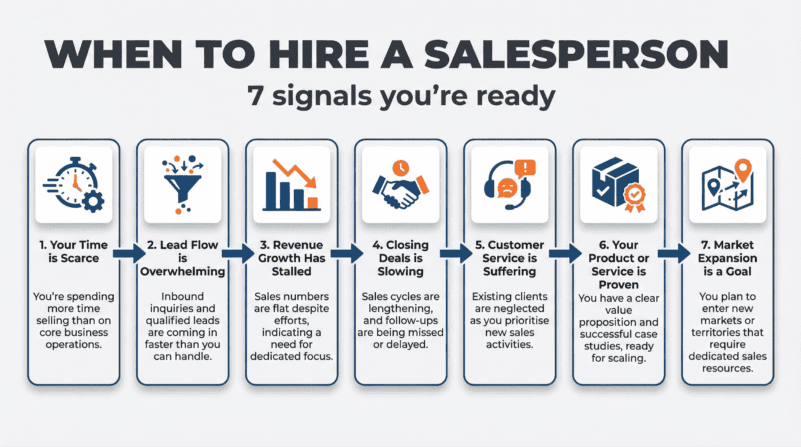
Quick Summary
Seven practical signals that show when you’re ready to hire your first salesperson, and when doing so would just waste cash and stall growth.
Takeaways
-
Close at least ten real, unaffiliated customers yourself before you even think about hiring a salesperson.
-
If sales is eating 20 percent or more of your week and the process is repeatable, you’ve earned the right to delegate it.
-
Don’t hire until you can clearly describe the anatomy of a win, from first conversation to signed contract.
-
Only make the hire when the pipeline is qualified, conversion is consistent, and the business can afford for the first attempt to fail.
A founder I work with rang me last month in a panic. Revenue had plateaued, his calendar was a catastrophe, and every other meeting was a sales call he was cramming between board prep and product reviews.
“I need to hire a salesperson immediately,” he said.
He was right about the pain. He was wrong about the timing.
He’d closed four deals. All four were people he already knew. His pitch changed every time he delivered it. He had no repeatable sales process, no documented objection handling, nothing a hire could actually follow. If he’d made a sales hire that week, he would have been paying an experienced salesperson a chunky salary to fail at something he hadn’t yet figured out himself.
This timing trap is the fastest way I know to lose money, confidence, and success in an early stage company. Hire too early and you set up your first salesperson to fail. Hire too late and your continued reliance on founder led sales becomes the bottleneck that kills growth.
A founder will always need to be involved in sales in some capacity – but you will need to manage your way out of the day-to-day operations at some stage. Getting that timing right is one of the most important decisions you will make as a founder CEO.
So if you’re a founder asking yourself: “When do I hire, who do I hire, and what do I hire them to do?”, here are seven signals to help decide whether making that first sales hire is the right move.
Signal 1: You’ve crossed the 10-customer gate
Before you hire, you must close the first ten to twenty unaffiliated customers themselves.
Unaffiliated means not your mates, not your former colleagues, not your investors’ portfolio. These are real customers who have looked at the market, had other options, and still chose your business.
This is non-negotiable for founders who want a business that can scale.
Those early sales conversations are product market research disguised as selling. In the early days, you are not just trying to close deals. You are finding product market fit. You are learning which outcomes people will pay for, which message lands, and what your market looks like. Every objection or hesitation you encounter, every time you’re told “that’s not quite what we need” is data that shapes your product, your positioning, and your pitch – and helps you build on your ideal customer profile.
If you outsource that learning to a salesperson too soon, you break the feedback loop. You end up with an early sales hire doing startup sales activity, generating noise, while you wonder why increasing sales feels like pushing a car uphill.
If you can’t point to at least ten real customers you personally closed, you’re not ready for a salesperson. You’re still doing first sales. You’re still testing product market fit. That is the founder’s job.
Signal 2: Sales is taking 20%+ of your week
You are ready to hire when sales-related work reliably consumes more than twenty percent of your week.
Below that, you probably don’t have enough volume for a salesperson to succeed. They’ll spend weeks “building pipeline”, sending messages, doing a bit of cold outreach, and feeling like they’re failing because nothing is closing. You’ll feel like you made a mistake. They’ll assume your business is broken. Nobody wins.
Above forty percent, you’re already paying a tax. You’re not being a CEO. You’re being the most expensive salesperson in the building. Product slows. Your manager team starts making decisions without you because they can’t get hold of you. You tell yourself you’re increasing sales, but the rest of the company is quietly wobbling.
Track it for two weeks. If it’s 20%+ week after week, founders are allowed to think about a sales hire and to plan the hire properly, not rush the hire out of desperation.
Signal 3: You can describe the anatomy of a win
Most founders want to hire because they’re tired of selling, not because they’ve worked out how to sell.
Before you hire your first salesperson, you need to be able to describe what a successful sale looks like from first touch to signed contract. Not a 40-page playbook. A simple, repeatable sequence.
Where do the best leads (and prospects) come from? What happens in the first meeting? What are the three objections that show up almost every time? What does “qualified” mean for your business? What’s the typical timeline? What triggers the buying decision? What makes customers say yes?
If you can’t articulate that, you are still in discovery. And discovery is founder led sales.
The test is simple. Could you sit an experienced salesperson down for an hour and walk them through your last five closed deals, and would they see a pattern? If every deal was a special snowflake that required founder heroics, you don’t have a sales process yet.
Signal 4: Your conversion rate is consistent, not lucky
Look at your numbers.
If you are reliably converting roughly fifteen to twenty-five percent of first meetings into customers over a meaningful sample, you have something that can be delegated.
If your conversion rate bounces between five percent one month and thirty percent the next, you don’t yet have repeatability. And repeatability is why you hire a salesperson in the first place.
A repeatable sales process shows up in consistency. It shows up in predictable objections. It shows up in you being able to say, “If we talk to twenty qualified prospects, we’ll probably get three to five customers.” That’s what lets a salesperson build success, learn the process, and succeed.
If you want a quick test, review your last ten qualified meetings and write the outcome next to each one. If the wins and losses feel random (different objections, different timelines, no obvious pattern) you’re not there yet. If you can see a shape to it, you are.
Signal 5: You’ve got more qualified pipeline than you can handle
If qualified deals are piling up and you are leaving deals on the table because you cannot physically get to the meetings, that’s a screaming signal to hire.
Be careful though: “more pipeline than I can handle” is not the same as “more leads than I can handle”. Leads are not prospects. Prospects are not deals. A business can drown in activity and still be starving for customers.
What you want is a pipeline full of the right person, the right problem, the right budget, and a clear next step. If you’ve got that and you’re still missing meetings, you’re constraining your own revenue and losing market share.
This is where a sales team starts to make sense. One salesperson can carry qualified conversations. Two salespeople can create momentum. And yes, you may soon be thinking about the second sales hire, but only after the first salesperson is working.
This is also when new market expansion becomes real. If you’re trying to enter a new market, you need more conversations than one founder can handle. If your company is pushing into a new market and you’re still relying on founder-led sales alone, you will move too slowly and lose market share. A new market punishes hesitation. In a new market, speed is a weapon, and speed comes from having a salesperson or a sales team running the process so you can close deals faster and keep increasing sales.
Signal 6: You’re no longer learning something new every call
In the early days, every call teaches you something. Objections surprise you. The use cases you hear about are ones you didn’t anticipate. You leave meetings with ideas for new products, or new ways to position what you already have.
At some point, that stops. The objections become familiar. The pitch barely changes. You know what works. The calls are still valuable, but they’re execution, not discovery.
That moment matters because execution is what you hire others for. Discovery is what founders do.
If you’re still surprised by what customers want, keep doing first sales. If you can predict the objections and the path to a decision, you’re ready for a salesperson to run the motion.
Signal 7: The business can afford for the first sales hire to fail
Your first sales hire might not work out. That’s not pessimism. That’s realism.
Some salesperson candidates are brilliant in a big company with a famous brand and inbound demand. Put them in a startup or early stage company and they freeze. Others look great in interviews and then melt the moment they have to create momentum in a new market.
Founders need two buffers: a money buffer and a decision buffer.
The money buffer is straightforward. Can your business afford to pay an experienced salesperson for three to six months and get zero revenue? If that would break the company, you’re not ready. Keep selling. Keep closing customers. Build the buffer. Then hire.
The decision buffer is harder. Founders need the willingness to act fast if the skills indicators are bad. Not because they’re a bad person. Because the role isn’t right, and your business can’t carry passengers. If you wait too long, that mistake is expensive.
The warning signs usually show up early. In weeks two and three, a struggling first salesperson is busy but not productive. Lots of activity, thin pipeline. They’re sending messages, doing research, attending internal meetings, but first conversations aren’t converting and nothing is moving forward. Most founders see this and assume the salesperson just needs more time. Some do. But the ones who don’t rarely turn it around after month two. Deciding in advance what good looks like at thirty, sixty, and ninety days means you’re making a performance call based on evidence, not guilt. That’s the decision buffer. It’s not about being ruthless. It’s about protecting the business. So you need to be in a financial position where you have the buffer to absorb a failing sales hire, and an emotional position where you are ready to move quickly if performance is poor. Only then are you ready to hire.
The founder’s paradox
What makes this whole situation complicated is that the founders who are most desperate to hire a salesperson are usually the ones least ready to do it.
They want relief. They want their diary back. They want someone else to carry the sales job. They want increasing sales without being the one making it happen.
And I get it. Founder led sales can feel like a second full-time role stapled onto being CEO.
But that’s not what the first salesperson is for.
Your first salesperson is a scale play. You hire once you’ve proved something works and you need more deals, more customers, and more revenue without you being in every call. You hire once the process is repeatable enough that a competent salesperson can run it and you can stop being the only person who can close deals.
That’s also why the “experienced salesperson from a big company” is a myth. Founders love the idea. It feels safe. It feels like your business is growing up.
It’s usually bollocks.
A big company salesperson is trained to run a machine. They’re not trained to build one. In a big company, marketing feeds them customers, the brand does half the work, and the market already knows who you are. They’re ‘just’ a sales rep. Drop that same person into a startup or early stage company where they are the only sales member in a small team and they can struggle because they’re being asked to do a completely different job to the one they know.
In an early stage sales environment, the first salesperson needs startup experience and the stomach for ambiguity. They need to be able to create momentum, qualify prospects properly, and keep moving when the answer is “not yet”. They need to build process, not just follow process.
So what’s the call?
If you’ve crossed the customer gate, if sales is taking 20%+ of your week, if you can explain the anatomy of a win, if conversion is consistent, if qualified pipeline is stacking up, if you’re not learning something new every call, and if the business can afford a failure, then hire, and make that hire count.
But hire from strength, not desperation. Hire knowing you’re still responsible for the message. Hire knowing founder led sales doesn’t disappear, it evolves. And before you ring the recruiter, ask yourself honestly: have I passed all seven signals? Or am I just tired?
Written by business coach and leadership coaching expert Dominic Monkhouse. You can order your free copy of his new book, Mind Your F**king Business here.