

Ten things make a culture strong: purpose, character, responsibility, learning, pride, expectations, practice, candour, rhythm and giving back. Here is what no one tells you: the versions that work at 30 people break at 100, the moment you stop hiring everyone and a layer of managers appears. Culture isn’t a checklist. It’s who you hire and what you tolerate.
There is a moment nobody warns you about. You’re walking through your own office, and it hits you that you don’t recognise half the people in it. You didn’t hire them. Someone you hired did. And you’ve no idea whether they’re any good.
That walk across the floor is the moment your culture changes. There is a before, and there is an after, and you usually only spot the line long after you’ve crossed it.
Roger Martin ran the Rotman School in Toronto for fifteen years and turned it into the best business school in Canada. Author of Playing to Win, and named the number one management thinker in the world by Thinkers50. He told me, when I spoke to him on Scale to Win, something that has stuck with me ever since: a company is nothing more than the sum of all the decisions its people make. Every single one. The big strategic calls you agonise over, and the thousand small ones you never see.
Sit with that for a second. When it was twelve of you, near enough every decision ran through you. The culture was you. At 200 people, thousands of decisions get made every week, in rooms you will never sit in, by people you have never met. So culture comes down to one question: what do those people decide when you’re not there?
I’ve lived both ends of this. As Managing Director of Rackspace UK and Peer 1 Hosting, I took both from nothing to £30m in five years, through two recessions. The growth came from the right people making the right calls in rooms I was nowhere near.
So before the list, the uncomfortable part. Almost everything written about company culture answers the wrong question. It hands you a tidy set of features and pretends culture is the same at 12 people as at 200. It is not. The features that build a great culture at 30 people are the same ones that crack at 100. Get this wrong, and the culture that built your first £10m is the thing that quietly stops you getting past it.
Why do most culture checklists fail scaling companies?
Because they freeze culture in time. Search the phrase and you get the same eight words every time: values, communication, recognition, inclusion, psychological safety. All true. All useless on their own. None of them tells you what happens to any of it as you grow, and growth is the only thing that genuinely moves culture. The list that builds you a great place to work at 30 people is the list that quietly betrays you at 100, because every item on it depended on you being in the room.
So the real work isn’t memorising the features. It’s knowing where each one breaks, and getting there first. That starts with one number.
What actually breaks your culture as you scale past 100 people?
You stop hiring everyone. A layer of managers slots in between you and the work. That’s the breakpoint. Brian Halligan, who built HubSpot, describes exactly this, and reaches for Dunbar’s number to explain it. Most people get Dunbar wrong here, so let me set it straight. The famous 150 isn’t how many colleagues your brain can carry. It’s the total number of stable relationships you can hold across your whole life, work and everything else thrown in together. Your family, your old friends, your neighbours, they all come out of the same 150. So once you account for the life people have outside the building, the number that actually fits inside a company is a good deal lower, nearer 100. That matches what I’ve watched happen. It starts to feel heavy around 70, and the real crack comes when the management layer goes in at about 100. Get that handover right and you climb out of no man’s land. Get it wrong and you stay stuck in it for years, wondering why the place doesn’t feel like it used to.
The mechanism is always the same. Early on, everyone you hire is a missionary. They’re there for the cause. Then you grow, and you start taking on mercenaries, there for the job. You hand hiring to other people. And they don’t do it the way you did. In their heads, the job becomes filling the seat. Not filling it with someone brilliant. Just filling it. That one shift, from “find me the best person alive for this” to “find me a person”, is how culture rots from the inside while every dashboard still looks green.
Your own job flips at the same time. In the early days it’s 90% sweat and 10% vision. At scale it is the other way round, and most of the drag you feel is not that you delegated too little. It’s that you delegated the one thing you should have held onto. I wrote about that handover in why growth stalls at 70 employees.
“The hardest discipline I ever kept as a Managing Director was staying close to who came through the door once I was no longer the one interviewing. Every instinct tells you to trust your managers and let go. The good ones earn it. But the day you stop caring who gets hired is the day your culture starts hiring itself, and it never hires up.”
Dominic Monkhouse, founder of Monkhouse & Company. Scaled Rackspace UK and Peer 1 Hosting as Managing Director. Coached more than 200 founder-CEOs through scaling.
Brian Chesky and I are at one on this. The grown-up advice goes “hire good people and get out of their way.” Chesky followed it at Airbnb, called the results disastrous, and set Paul Graham writing about founder mode. So no, you don’t hand hiring to your executive team and step back, not even once you have one.
And here is the part people misread. It’s not that you distrust your executives, or doubt they’re any good. It’s that when the CEO is in the hiring, you hire better people. A founder selling the mission pulls in people who would never have joined for an executive alone. That is the missionary thing again, the ones who come for the cause and not just the salary.
I used to spend a fifth of my week recruiting. These days I spend a big chunk of mine helping clients do the same. And if your exec team resent you being in the room for hiring, that tells you something worth knowing. Replace them with people who understand why you’re there. There is more on this in why founder mode beats manager mode.
How do you know if your managers are killing your culture?

Once there is a layer, that is where culture lives or dies, so that is where you look. Gallup pins 70% of the gap between a great team and a miserable one on a single person: the manager. And the trend is grim. Gallup’s State of the Global Workplace 2026 has global engagement at 20%, the lowest since 2020. But one figure should keep you up at night: manager engagement fell to 22% in a single year, down five points, the steepest drop they’ve ever recorded. The exact layer you bolt on to scale is the layer checking out fastest. Fixable, though, not fate. In the best-run companies, 79% of managers are engaged, four times the average. Ignore it and the rot starts in the middle and works both ways.
The clever part is you never have to ask anyone “is your manager any good?” You ask people about their own day, and the answers tell on the manager for you. Four questions from Gallup’s Q12 do most of the work:
- Do you know what is expected of you at work?
- Do you have the materials and equipment you need to do your work right?
- At work, do you have the opportunity to do what you do best every day?
- In the last seven days, have you received recognition or praise for good work?
Nobody rated their boss. But low scores here mean a manager who has not set expectations, has not cleared the path, has not put people where they’re strong, and has not noticed when they do something well. That is a bad manager. Named, without anyone having to name them.
Hiring the wrong people keeps you in the weeds.


The 10 most important features of a strong company culture
Here they are. For each one: what it is, and what starts to break the day the management layer goes in. Scan the table, then take the ones that are already fraying on you.
| Feature | What it builds | What breaks at scale |
|---|---|---|
| 1. Purpose | A reason to exist beyond profit | Gets diluted as mercenaries outnumber missionaries |
| 2. Character | The type of people you hire | Slips when hiring is delegated and the bar drops |
| 3. Responsibility | People owning outcomes | Diffuses as layers blur who owns what |
| 4. Learning | A team that gets better | Stalls when no one has time to coach |
| 5. Pride | Discretionary effort | Fades as people feel like a number |
| 6. Expectations | Clear standards | Go fuzzy when managers do not reset them |
| 7. Practice | Preparation that drives performance | Dropped under growth pressure |
| 8. Candour | Honest, direct feedback | First casualty of a bigger, more political org |
| 9. Rhythm | A predictable operating cadence | Breaks when informal updates stop scaling |
| 10. Giving back | A wider sense of contribution | Gets deprioritised as the org turns inward |
The 10 features of a strong company culture, and the failure mode each one hits as you scale.
1. Purpose
Purpose is the answer to “why are we all here?” Not the version laminated in reception. The real one. I asked Horst Schulze, who built the Ritz Carlton, what his was, when he came on Scale to Win. “To be the finest hotel company in the world.” Seven words. He drew a hard line between managers and leaders: managers run the place, leaders make it blindingly obvious why it’s worth running. Purpose is the first thing to thin out as you grow, because every mercenary you hire turned up for the job, not the cause. Your task is to keep saying it long after you’re sick of the sound of your own voice. The day you go quiet is the day it dies.
2. Character

Character is who you let on the bus, because the people you choose become the culture. You are hunting for instinct, not interview polish. I know two managers who “accidentally” drop a stack of paper in front of a room of candidates. The three who get up to help are the three they hire. The one who carries their mug back to the kitchen after the interview just told you they’re accountable, and they didn’t say a word. Netflix wrote the original playbook on this. Patty McCord, their Chief Talent Officer for fourteen years, built the famous culture deck with Reed Hastings, and when she came on Scale to Win she put it plainly: pack the place with talent faster than complexity grows, then manage with context, not rules. Hire the top 5 to 10% for the role and you barely need a rulebook. The catch is that A-players know what great looks like and B-players do not, so the day a B-player starts hiring, the bar drops a notch.
3. Responsibility
Responsibility means people own the outcome, not the task. In a strong culture you’re not dragging anyone along. They’re self-propelled, and they take it to heart when it goes wrong. Most managers get this backwards. They think the job is to motivate people and hold them to account. It cannot be done. You cannot pour motivation into someone who showed up without it, and you cannot hold a person to a standard of ownership they were never built for. The smart ones don’t try. They hire people who turn up motivated and responsible, and then they get out of the way. Gallup’s CliftonStrengths even tests for it. Responsibility is one of its 34 themes, that near-compulsive need to do exactly what you said you’d do. Run it across your shortlist before you hire, or across the team you already have when the culture feels off, and the answer tends to be sitting right there.
None of which means you wave through the misses. Every value you celebrate but refuse to enforce quietly taxes trust. Keep one brilliant jerk who hits his numbers while flattening everyone around him, and you’ve taught the whole company the values are for the website. Dharmesh Shah of HubSpot calls it culture debt. Every time you drop the bar to fill a seat, you borrow against the culture at an interest rate that makes technical debt look cheap. It compounds in silence. Then it goes off, somewhere north of 100 people, all at once.
4. Learning
A strong culture learns. People don’t grind harder. They get visibly better at the craft, because the business backs it with time and money. Coaching, reading, real post-mortems that go hunting for the lesson and not the culprit. And it starts at the hiring gate, same as responsibility. CliftonStrengths has a theme for this one too, Learner, the people who are genuinely lit up by getting better at something. At Rackspace and Peer 1, three quarters of my team scored high on Learner and Achiever, the get-shit-done strength. That mix was not luck. It was who we hired. Learning is the first thing to stall when you scale, because everyone is suddenly too busy, and development is the easiest line to score out when the pressure comes on. So it gets scored out. And then you stand there a year later wondering why the team that got you to £10m can’t get you to £30m. They’re the same people. You just stopped growing them.
5. Pride
Pride is what makes someone do the bit they were never asked to do. Want a fast read on whether you have it? Look at your own swag. You handed out the polo shirts and the hoodies with the logo on. Do people actually wear them, out in the world, on a weekend, when nobody’s making them? That is the tell. At Peer 1 my support team went one better. They came up with their own slogan, Challenge Accepted, and wore it across the back of their shirts, chests out. Nobody in marketing told them to. That’s pride, and you can’t buy it or mandate it. At the best places to work, 85% of people give that extra effort, against about 60% everywhere else. That gap is the whole ballgame. Pride comes from doing work that matters next to people you rate, and it’s the first thing to fade the moment someone stops being a name and starts being a line on a headcount report. The fix costs nothing. Notice good work, out loud, often, and mean it.
6. Expectations
Clear expectations are the floor everything else stands on. People can only hit a standard they can see. It’s no accident that the first Gallup Q12 question is “do you know what is expected of you?” Get that wrong and nothing above it holds. At scale, expectations blur, because the person who set them, you, is no longer in the room, and the managers carrying them rarely carry them with the same conviction. So write them down. Say them again. Say them a third time when you are bored of saying them. Vague is how good people end up failing at things nobody ever told them mattered.
7. Practice and preparation
High-performing teams rehearse. The pitch, the board meeting, the hard conversation, the launch. What looks like a brilliant performance on the day is almost always preparation nobody saw. Under pressure, prep is the first thing to go, because it feels like time you haven’t got. It’s the time that buys the result. Treat it as a standard, not a luxury you get back to when things calm down. They never calm down.
8. Candour
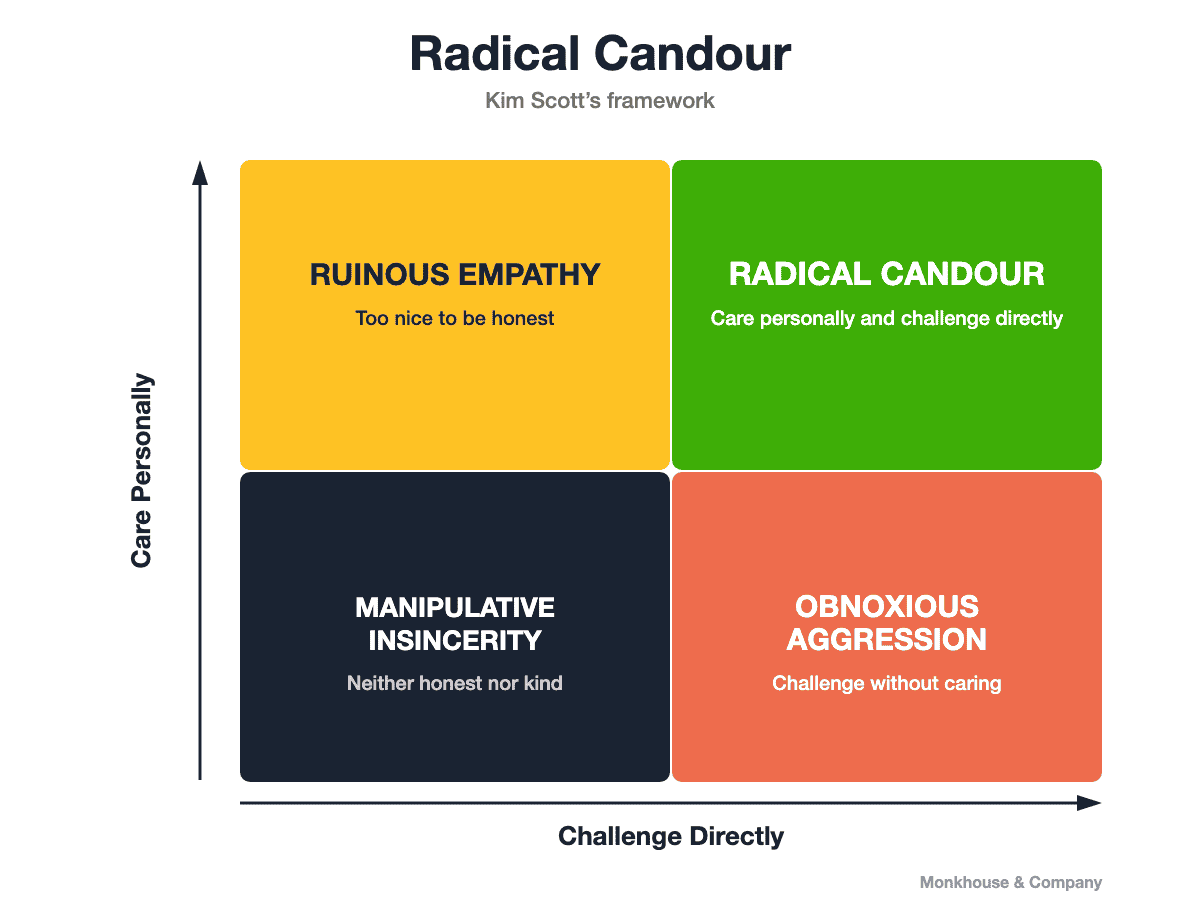
Candour is telling people the truth, to their face, in the moment, without the corporate bubble-wrap. Kim Scott wrote the book on it, Radical Candour, and when she came on Scale to Win she boiled it down to two things you have to do at once: care personally and challenge directly. Drop either one and it falls over. Challenge without care is just brutality. Care without challenge is what she calls ruinous empathy, the kind that lets bad work slide because you’d rather be liked than honest. It runs on psychological safety: people speak up because it’s safe, not because they’re reckless. PwC found in 2025 that the people who feel safest are 72% more motivated than the people who keep their heads down. Candour is usually the first casualty of growth. The place gets bigger, more layered, more political, and everyone quietly works out that honesty has a price. Guard it like the business depends on it, because it does. The day your people stop telling you the truth is the day you start flying blind and calling it calm.
9. Rhythm
Rhythm is the heartbeat. The daily huddle, the weekly meeting, the monthly review, the quarterly plan. In a small company, alignment happens by osmosis, because everyone can hear everyone. Past 100, osmosis dies, and without a deliberate beat the place drifts out of time with itself and nobody can say exactly when it happened. Rhythm is how you rebuild the alignment you lose the day you can no longer fit everyone in one room. Done properly it runs itself, which is the whole point of building an operating rhythm that scales.
10. Giving back
The strongest cultures look up and out. At customers, at the community, at something bigger than this quarter’s number. It’s what makes people care about the work beyond the wage. At Peer 1 we gave everyone a paid day a year to go and volunteer. The clever part was you could gift your day to someone else. So a handful of people pooled theirs and took multi-week trips to help a local charity, and the rest of us felt the pride of that without leaving our desks. One small policy, and the whole company had a stake in something beyond the quarterly number. As you scale, the pull is always inward, drowning in your own complexity, and giving back is the easy thing to quietly drop. Do not drop it. The day your people decide this was only ever about the money is the day they start working like it was.
Then there is the company that rewrote what this looks like for me. I have spent five years keynoting Culture Day for Smartsourcing, a business process outsourcer in Cebu in the Philippines. Culture Day falls on a Saturday. Unpaid. A day off. And almost the entire company turns up anyway, last year all but 17 of around 1,500 of them. In the UK my CEOs struggle to get people in on the days they’re paid for. HR Asia has named Smartsourcing one of the best companies to work for in Asia five years running, and half of every new hire walks in through a referral from someone already there. But here is the part that tells you everything. In December 2021, Typhoon Odette, the third largest storm in Cebu’s recorded history, left a third of their people homeless. So they rebuilt their homes. The founder, Mike Selfe, raised a quarter of a million dollars with his customers and partnered with Habitat for Humanity to do it. That’s what great culture is. Not the slide and the free lunch, though they have those too. It’s what a company does when its people are on the floor.
Does a strong culture actually make you more money?
Yes, and not by a rounding error. Great Place to Work ran the numbers on its 100 Best: a 13.4% annual stock return over 28 years, against 9.2% for the Russell 3000. They pull 8.5 times the revenue per employee of the average firm, and lose two-thirds fewer people. Culture isn’t the soft stuff you get to once the real work is done. It’s the stuff that compounds.
The downside is just as blunt. McKinsey’s State of Organizations 2026 found 75% of companies are failing to build a high-performance culture, and the ones who get the balance of people and performance right are more than four times more likely to stay top of their field nine years out of ten. And when MIT Sloan ran 1.4 million Glassdoor reviews in 2022, a toxic culture turned out to be 10.4 times more powerful than pay at predicting who walks out the door. You don’t lose your best people to a bigger offer down the road. You lose them to how it feels to work for you.
How do you measure company culture?
With instruments, not impressions. “We’ve got a great culture” isn’t a measurement. It’s a hope with good PR. Three tools turn the hope into evidence. Gallup’s Q12 measures engagement, and through those four foundational questions, the quality of your managers. The Competing Values Framework from Cameron and Quinn, run through the OCAI, maps your culture across four types, clan, adhocracy, market and hierarchy, so you can see the gap between the culture you have and the one your strategy actually needs. And Edgar Schein’s three levels explain why most culture work fails: the values on your wall sit at the shallow end, while the real culture lives in the assumptions nobody ever says out loud. Measure the assumptions and the behaviour. Not the posters.
Frequently asked questions
What are the 5 C’s of company culture?
The 5 C’s of company culture are clarity, commitment, consistency, community and contribution: be clear about purpose and standards, commit to them at the top, apply them the same way every time, build belonging, and tie the work to something bigger. It’s a useful memory aid, no more.
The flaw every culture acronym shares is that it describes the finish line and says nothing about the climb. At 30 people you hold all five in place just by turning up. Once you’re not in the room, every one of them rests on your managers holding the line as hard as you did, and that’s exactly where they slip.
What are the 7 features of culture?
The seven features of culture come from anthropology, not management: learned, shared, symbolic, integrated, dynamic, transmitted and adaptive. Only one should keep a founder up at night, and that’s dynamic. Culture is never finished. It moves every time you hire, promote, or tolerate something you shouldn’t.
That’s why holding it together takes work all year, not a values offsite and a branded mug. The other six just describe what a culture is. The dynamic one decides whether yours survives the climb past 100.
At what size does company culture break?
There’s no hard line, but the symptoms arrive on cue. Around 70 it starts to feel heavy. By 100, once the management layer is in, you stop knowing everyone’s name, decisions get made differently from how you’d have made them, and you’re the last to hear when something’s wrong. That’s the tell, not the headcount.
People reach for Dunbar’s 150, but treat it as a rough ceiling on relationships, not a fire alarm for your org chart. Watch the symptoms. They turn up long before any number you’d put in a board deck.
How do you fix a broken company culture?
You fix it where it broke: your hiring bar and your managers. But there’s a number sitting underneath that, and it’s 30%. Find or recruit 30% genuine believers, your A-players, and the culture starts to move on its own. Below a third, no away-day or fresh set of values will save it.
Moira Clark, Professor of Strategic Marketing at Henley, ran a project with a high-street bank in Sheffield. They took the manager from the best branch and dropped them into the worst one to turn it around. Nothing changed. The branch only moved when they transplanted 30% of the people from the best branch into the worst one. Malcolm Gladwell lands on the same figure in Revenge of the Tipping Point, his “magic third”: a group tips when roughly 30% of it believes. Can’t get to a third? Then you’re up shit creek without a paddle, and the only way out is to change who you hire, who you promote, and who you stop tolerating.
What should you do next?
If your culture used to run itself and now feels like wading through treacle, you’re sitting right on the transition. You have stepped back from hiring, the management layer has gone in, and suddenly nobody quite owns the bar. That’s not a problem a values workshop fixes. It looks like a culture problem, but it’s really a scaling one.
Get it right and culture becomes the cheapest growth lever you own. People stay. They give you the extra. The bar holds without you in the room. Get it wrong and you spend the next two years firefighting people problems your own growth created.
So, one question worth sitting with. Your next hundred hires are coming whether you’re ready for them or not. The only thing still in doubt is whether they make the place faster, or quietly bury the thing you spent all these years building.
Four ways to take this further
- Book a call. If your culture is starting to feel heavy as you grow, I can help you work out whether the real problem is your hiring bar, your management layer, or your own reluctance to let go of the right things. No obligation, no pitch. You’ll know quickly whether this is the right kind of help.
- Grab the book. Mind Your F**king Business gives founder-CEOs a practical way to stop being the bottleneck and build a company that can scale without them in every room.
- Read why growth stalls at 70 employees. Start here if the business has started to feel heavy and you can’t put your finger on why.
- Subscribe to the newsletter. Practical scaling lessons for founder-CEOs, including how to hold culture together through the management-layer transition.
Your move. Pick the one feature on this list that is already fraying, and go fix the hire or the manager underneath it. This week. Not next quarter.
About the author
Dominic Monkhouse scaled Rackspace UK and Peer 1 Hosting as Managing Director, taking both to a £30m annual run rate. He’s the founder of Monkhouse & Company.
What should you do next?
If this post has annoyed you slightly, good. The issue is probably not effort. It is design. The business is asking you to carry decisions, standards and exceptions that should now belong inside the team.
The goal is not to disappear. The goal is to build a company where your best work is not dragged back into every operational tangle.
That is the point. Scaling is not adding more people around the same bottleneck. It is rebuilding the business so the bottleneck is removed.
Four ways to take this further
- Book a call. If growth is now making the company slower, heavier or more dependent on you, I can help you decide whether the constraint is people, strategy, execution, cash or your role as founder. No obligation, no pitch. You will know quickly whether this is the right kind of help.
- Grab the book. F**k Plan B covers these principles in more depth, with the practical founder lessons behind customer obsession, honest communication, hiring, small teams and managers who coach.
- Watch: 5 founder mistakes that kill growth. Five founder bottlenecks that quietly stop growth between 50 and 100 people, and how to clear them.
- Subscribe to the newsletter. Get direct, practical thinking on scaling, founder bottlenecks, leadership rhythm and building a company that can run without you in every room.
Your move. Open Slack, Teams or your inbox. Find the decision that should not have come to you this week. That is where the scaling work starts.