
Quick Summary
Pedalling through the Indian desert reminded me of founder life, you ride with others, but the real fight, the pain and the doubt, is always yours alone
Takeaways
- Founder life mirrors the ride, you’re part of a pack but the hard yards are always on your own legs.
- Growth feels communal, but the pressure, doubt, and grit are a brutally solo experience.
- No one can carry your bike or your business, they can only draft you for a moment.
- The real work is learning to push on when the peloton disappears and it’s just you and the desert.
The sun rises over endless dunes as I set off on leg 14 of Ride25 in India, a five-day, 500-mile slog from Jaisalmer towards Delhi. Ride25 isn’t some casual spin with mates; it’s a rolling caravan of business leaders, adventurers and the quietly unhinged, all pedalling across countries for charity, camaraderie and the sheer joy of suffering together.
We ride in a peloton when we can – drafting off each other, sharing wind resistance, shouting warnings about potholes, cows and the occasional tractor drifting across the road. But even surrounded by brilliant people, even with the laughter, the shared exhaustion, the group photos and the evening beers… there’s a truth you can’t escape out here:
No one can ride your bike for you.
They can encourage you.
They can pull you for a few kilometres when you’re flagging.
But the effort?
The burning legs?
The saddle sores?
The heat bouncing off the tarmac like a blast furnace?
That’s yours alone.
It’s a strange feeling – being part of a team but locked in your own private battle. In the peloton you feel connected; fall off the back and the desert swallows you into complete isolation. Every rider knows that feeling: surrounded by people, yet somehow utterly alone with your thoughts, your doubts, your grit.
And that, in a nutshell, is founder life.
Being a startup leader is its own kind of ultra-endurance ride. You’ve got no roadmap, no GPS, just a mission and a stubborn confidence you can make it. In my case the terrain is real desert; in yours it’s the gruelling plain of scaling your company. Either way you’re under a relentless sun – physical heat or fundraising pressure – and sometimes it feels like no one truly understands your slog (unless they’ve done it themselves).
Making it relevant
McKinsey’s recent piece “The Loneliest Job? How top CEOs manage dilemmas and vulnerability” paints a picture of suited chairmen balancing decades-old legacies and weekly shareholder calls. But there’s a gulf between a 100-year-old conglomerate CEO and a founder-CEO wrestling with the next hire or the next investment round. McKinsey’s insights are valid for their world, but when you’ve only just added a second marketing person, they read like Tour de France coaching notes handed to someone wobbling along on stabilisers.
In this post I’ll rip up each of McKinsey’s five “dilemmas” and re-frame them from a founder’s gritty perspective. By the journey’s end you’ll know exactly how your CEO ride really feels – and what to do about it.
Dilemma 1: Standing on shoulders vs carving your own path
McKinsey talk about “preserving the core while innovating for the future”. Lovely. In their world, the “core” is a decades-old product line with a museum exhibit’s worth of history behind it. For founder-CEOs, the so-called “core” was whatever we hacked together on day one – usually a product we prayed wouldn’t collapse as soon as a customer poked it.
And let’s be honest: the core isn’t some venerable legacy. It’s you.
The product, the culture, the operating manual – it’s all living rent-free in your head. Your “long-standing team values” are basically your childhood, your instincts, and whatever you ranted about in last week’s stand-up. McKinsey warn about “honouring history and preserving assets”, but most founders are too busy worrying about the intern still maintaining the original codebase built at 2 a.m. from their kitchen table.
One of the hardest things about life as a founder-CEO is that you’re not standing on anyone else’s shoulders. You’re carving the path as you go. It’s freeing and terrifying in equal measure. The real dilemma is simple:
Do you keep pushing the thing that works just enough, or do you back a new idea and hope it isn’t a mirage?
Strengthen what works
The solution isn’t sentimentality or chaos. It’s recognising that innovation isn’t an add-on – it is your core. If you built something from scratch, you’re already wired for change. But don’t mistake that for a licence to tear everything up. Don’t dismantle the product or the team keeping you alive unless you can clearly see a better path. Keep strengthening the thing that works (even if it’s held together with duct tape and determination) because it’s the only thing buying you time for what’s next.
In practice, split your time between firefighting today and plotting next quarter’s strategy. The mistake is staying too long nursing a stable but dying cash cow, or chasing shiny ideas with no revenue anchor. Align your team around a clear, near-term mission and pour every scrap of momentum into it.
Dilemma 2: Sprint or marathon: Survive today and tomorrow
In the founder-CEO world, this really is the classic “short term vs long term” wrestling match. McKinsey talk about CEOs being pulled between “doing the right thing for the future” and “boosting short-term value”. Peter Olson even admits he “focused too much on making short-term targets and not enough on culture and talent development” in his early days as Random House CEO.
But it’s different for founders. You don’t get to choose one or the other – you have to make both work.
Short-term survival matters.
So does culture.
They’re both wheels on the same bicycle. And if there’s one thing I can confirm from the last week of my life, it’s that you need two wheels on your bicycle.
Everything in balance
Your bank balance or investor patience is the sunset you’re racing. But if you kill culture in the name of short-term numbers, you’re torching the very thing that makes long-term performance possible. That’s the trap. McKinsey suggest a portfolio of bets; some near-term, some future-focused. In founder-land, that’s not a luxury, it’s the job: make today work and build the system that pays off tomorrow.
The real skill is knowing which small number of things move revenue now, while relentlessly protecting the cultural foundations that mean you’ll still have a team, a customer base and a functioning company a year from today.
So you get scrappy. If the board wants “short-term wins”, that’s often code for “keep the lights on, mate”. Customers just want the product not to crash. Your instinct is: cut the fluff, double down on what keeps cash flowing, push riskier bets later.
The hard bit is avoiding stupid short-term spikes – binge-hiring to impress investors, discounting your way into a margin death spiral – that wreck your runway. On the flip side, waiting until the product is “perfect” before selling anything is a great way to run out of money quietly.
Dilemma 3: All-star cast or loyal crew?
McKinsey’s third dilemma – “managing a team of individual stars versus maximising collective performance” – hits founders where it hurts.
At the start, everyone is a star, riding or dying with the vision. Everyone’s doing 12 jobs at once and calling it “entrepreneurship”. The founding crew were in the trenches with you at 2 a.m. Why on earth would you ever let them go? Then you scale, hire specialists, and suddenly you’ve got veterans vs newcomers, product purists vs revenue hawks, the old guard vs the people who actually know how to run a modern system. And this is where it gets emotional.
The founder’s dilemma here is raw: you feel everyone is family, so you’re terrified to cut anyone. But holding onto a hero who can’t adapt doesn’t preserve your culture – it poisons it.
Even McKinsey’s CEOs says one of their big regrets is not moving toxic high performers on fast enough. In founder-led firms that pain is ten times sharper because everything is so much more personal.
So what do you do? Get crystal clear on roles and values. If someone is undermining others or hoarding decisions, confront it. Coach them. If nothing changes, your job is to say, “We’re better off without you,” before more people head for the exit. It’s harsh, and it hurts, but in a scaling company it’s self-sabotage to keep a cultural arsonist.
Roles people win in
At the other end of the spectrum, founders often over-value loyalty. You might have people who’ve “been there since day one” and new hires who bring the skills you now need but don’t yet get the culture. The answer isn’t blind loyalty or ruthless churn. It’s to move people into roles they can win in, invest in development, and be honest when someone no longer fits.
Firing an ill-fit sends a clear message: this ship sails on competence and teamwork. The people you want to keep will respect that.
Dilemma 4: Standing in the way of control
McKinsey’s fourth dilemma – “empowering others while maintaining control of outcomes” – nails a core founder tension. They talk about delegation as a vital skill; founders live the ugly version of that sentence.
We say we want a team who “step up”. Then the work comes back not quite how we’d do it, we fix it because that’s quicker, and suddenly we’ve rebuilt the job we hired someone else to do.
The thing is we don’t cling to decisions because we’re power-hungry control freaks. Well, maybe a little bit.
But mainly we do it because we’ve got standards, and when something goes wrong it’s our neck in the noose. But if every decision, approval and bollock-saving moment has to go through you, congratulations — you’ve turned yourself into the world’s most overpaid helpdesk.
Hire experts – and trust them
McKinsey quote Peter Olson saying CEOs often think only they can make the best calls. But if you’ve actually hired properly, your team should know their area better than you do. That’s the whole f**king point.
To get it right, delegation has to be to outcomes, not tasks. Set the goal (“We need 20% more conversion next quarter”), give the guardrails, then get out of the way. If everything still has to be done your way, you haven’t built a leadership team – you’ve built an entourage of assistants waiting for instructions.
Practically: hire slowly, fire fast, define roles, agree metrics, and create simple check-ins so you’re not hovering. Accept that some things will be done differently (and sometimes worse) on the way to being done without you. Drop the perfectionism and focus on “95% of the work done well by someone else” instead of “100% done by me at midnight”.
You can’t build a scalable company while you’re still the hero.
Dilemma 5: Mission, not misery: Being CEO and human
McKinsey’s final dilemma is basically: “don’t become a 24/7 CEO-bot with no soul.”
Founders don’t need that warning – we face that challenge every day.
You didn’t inherit the business from Great-Uncle Bertie; you pulled the damn thing into existence out of nothing. So it’s hardly surprising that after two years of chaos you wake up and realise your social life is just a string of group WhatsApps where you don’t even get the in-jokes any more, your family think you’ve joined a cult, and the last time you took a weekend off was because Boris said you had to stay at home.
Some founders even brag about this self-destruction. “Big pitch tomorrow,” they’ll crow as they make an excuse for missing a relative’s birthday party. That’s not commitment. That’s a slow-motion identity collapse.
McKinsey do nail one truth: a mission saves you. A real one, not a marketing line – the actual reason you started all this madness. If you hold onto that, it becomes your compass for decisions, not the never-ending KPI hamster wheel.
The fix isn’t complicated: pick a few boundaries and actually keep them. No email on Sunday evenings. Actual holidays. Offsites that aren’t just PowerPoint with different biscuits.
And bring your human side to work. Tell people what else matters to you. It makes you relatable and reminds you that you exist outside this machine you’re building.
And listen – if something feels ethically dodgy?
Walk away.
No exit is worth becoming someone you don’t respect.
The finish line
When I finally rolled into the finish at Tijara Fort, I was filthy, exhausted and sunburnt – but grinning. Founders who get through hypergrowth often describe the same feeling. The grind doesn’t just build the business; it builds you.
So here’s the challenge. Will you keep pedalling in circles, treating work as your entire identity? Or will you do the harder, braver thing – build a business that can thrive without you and a life you actually want to live?
Because great founder CEOs don’t just build great companies. They build great lives too.
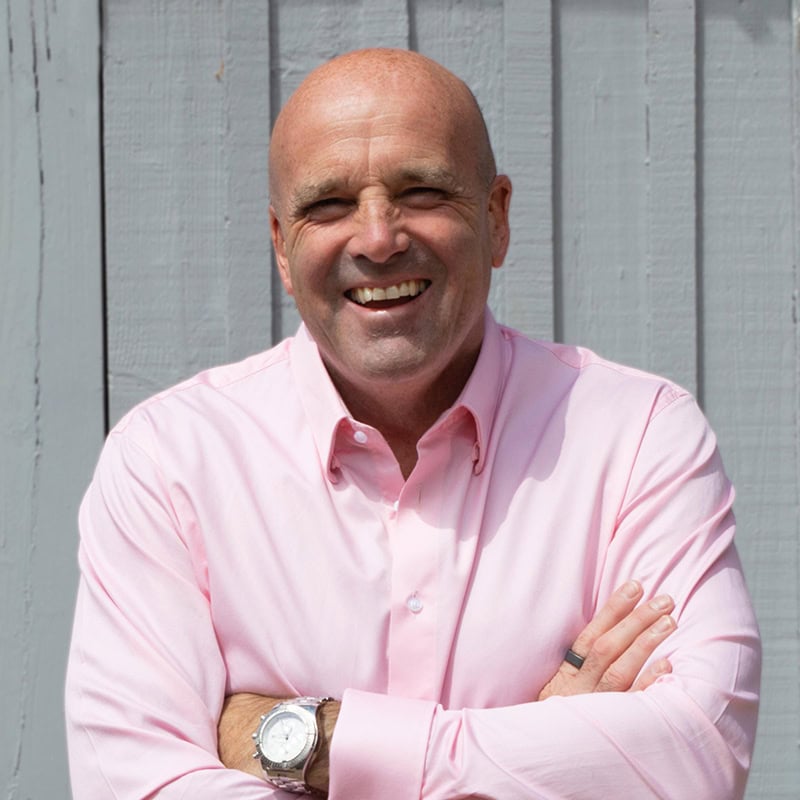
Written by business coach and leadership coaching expert Dominic Monkhouse. You can order your free copy of his new book, Mind Your F**king Business here.