
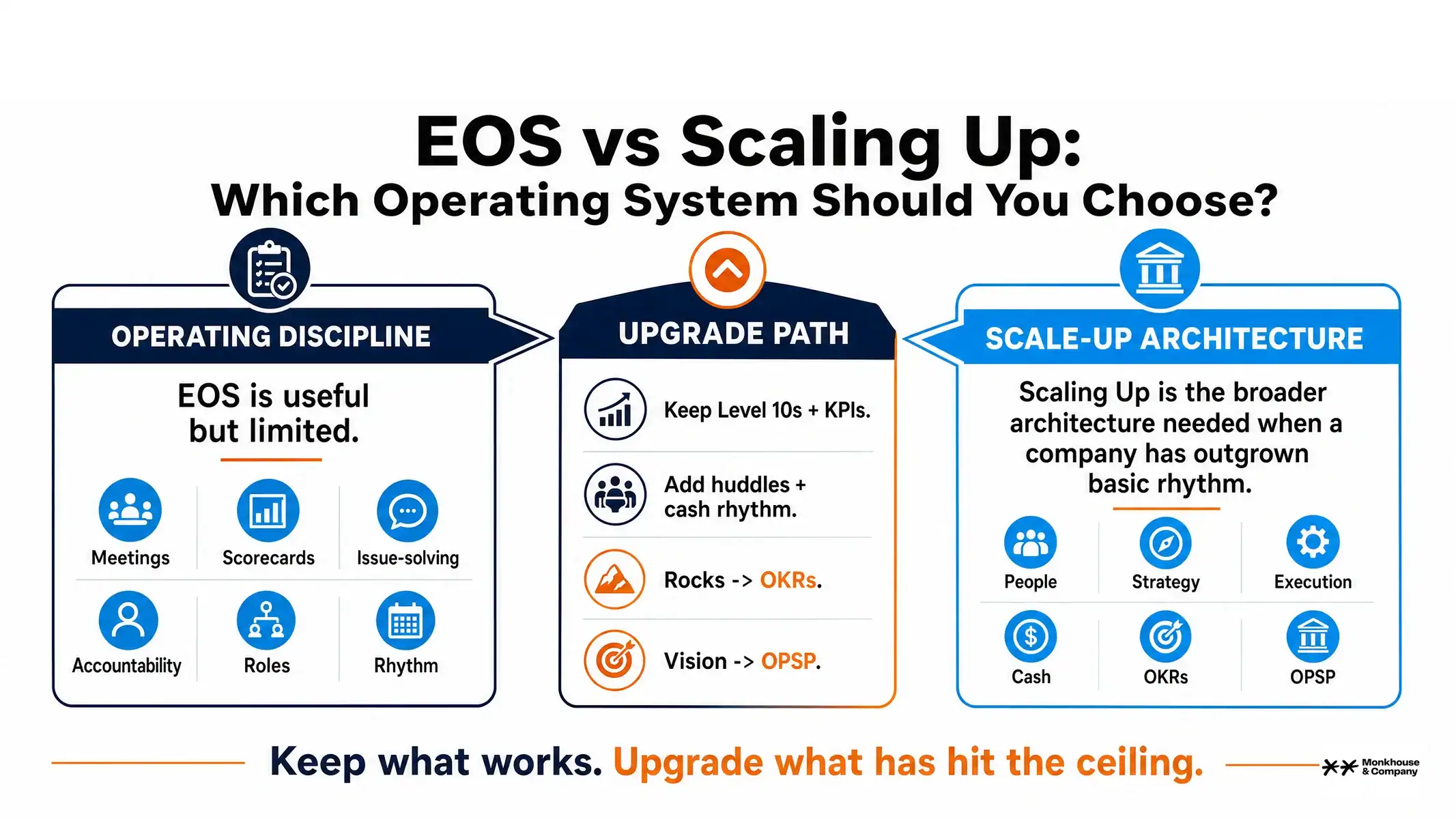
EOS is a simple Business Operating System (BOS) for alignment, accountability and meeting rhythm. Scaling Up is a broader BOS for people, strategy, execution and cash. If you already use EOS, keep what works. Level 10s and KPIs can stay. Add daily huddles, replace Rocks with OKRs, turn vision into an OPSP and start managing cash properly.
You do not choose a Business Operating System when everything is calm. You choose one when the business has started to outrun the way you manage it.
The weekly meeting has become a load of bollocks. The same issues come back every quarter. Your leadership team agrees in the room and drifts apart by Thursday. Cash is tighter than it should be. And you are still the person everyone comes to when the system jams.
That is usually when someone says, “We should install EOS.” Someone else says, “No, we need Scaling Up.” Then the debate turns into methodology bingo.
Wrong question.
The real question is not whether EOS or Scaling Up has the better brand. The real question is whether you have hit the Founder Ceiling, and whether you are still the real BOS.
Current comparison pages tend to argue from the system they sell. EOS Worldwide’s EOS vs Scaling Up page frames EOS as the simpler operating system. Scaling Up’s comparison page emphasises broader strategy and cash disciplines. Align Today’s July 2025 comparison takes a more blended view.
Fine. But the useful question is diagnostic. What is actually breaking in your business?
What is the difference between EOS and Scaling Up?
A Business Operating System, or BOS, is the way your company actually runs. Not the poster on the wall. Not the offsite deck. The real rhythm of meetings, priorities, decisions, cash, accountability and tradeoffs.
What is EOS?
EOS, the Entrepreneurial Operating System, was created by Gino Wickman and popularised through Traction. It is built around six components: vision, people, data, issues, process and traction, according to the official EOS Model. It gives you a simple language for priorities, Level 10 meetings, issue solving and accountability.
What is Scaling Up?
Scaling Up, created by Verne Harnish from the Rockefeller Habits work, is built around four decisions: people, strategy, execution and cash, according to Scaling Up Coaches. It still cares about meetings, metrics and accountability, but it refuses to pretend execution is the whole game.
Where EOS and Scaling Up come from
That overlap is not an accident. Wickman was not inventing in a separate universe. Scaling Up UK says he used the Rockefeller Habits tools and techniques to scale and exit his own company, then became one of the early Gazelles coaching partners before creating a modified system of his own. That is why EOS and Scaling Up share so much DNA: rhythm, priorities, metrics, accountability and issue-solving.
My first encounter with that lineage was in 2002, when I bought Verne Harnish’s Mastering the Rockefeller Habits while running Rackspace UK. I was Managing Director, but my own background was sales and marketing, not the backend operating machinery of a scale-up. I needed a system that would help us build operating rhythm, manage the culture and keep what made the company special as we grew.
When the business was small, culture felt like our superpower. The danger was that scale would turn it into folklore. Rockefeller Habits gave me a way to codify the rhythm. Scaling Up, published in 2014, evolved that work into the broader people, strategy, execution and cash architecture.
EOS is a simple BOS for alignment, accountability and traction.
Scaling Up is a broader BOS for people, strategy, execution and cash.
The biggest difference: a vision summary versus a strategic plan
The clearest single difference is the planning document. EOS gives you a vision summary, the Vision/Traction Organiser. Scaling Up gives you a One-Page Strategic Plan (OPSP) that turns strategy into an execution plan reaching individual leaders, used every quarter to set priorities: Rocks in Scaling Up, or OKRs when I work with clients.
That difference sounds small. It is not.
EOS asks: can you get aligned, accountable and disciplined?
Scaling Up asks: can your business scale through people, strategy, execution and cash without making you the constraint?
You don’t have to rip EOS out to move to Scaling Up
That is why moving from EOS to Scaling Up does not need to become a religious conversion. If you already use EOS, you may have useful operating muscle in place. Level 10 meetings can stay. KPIs can stay. The issue-solving habit can stay.
You do not need to burn the rhythm down. You need to upgrade the parts of the BOS that have hit a ceiling.
At Monkhouse & Company, the upgrade usually looks like this:
- Keep Level 10 meetings where they are working.
- Keep useful KPIs and scorecards.
- Add daily huddles where the business needs faster alignment.
- Swap Rocks for OKRs, so priorities connect to measurable outcomes.
- Turn vision work into a proper One-Page Strategic Plan.
- Add strategy and cash management as active operating disciplines.
Do you need the same system at 25 people and 100 people?
That matters because a company at 25 people and a company approaching 100 people are not wrestling with the same problem.
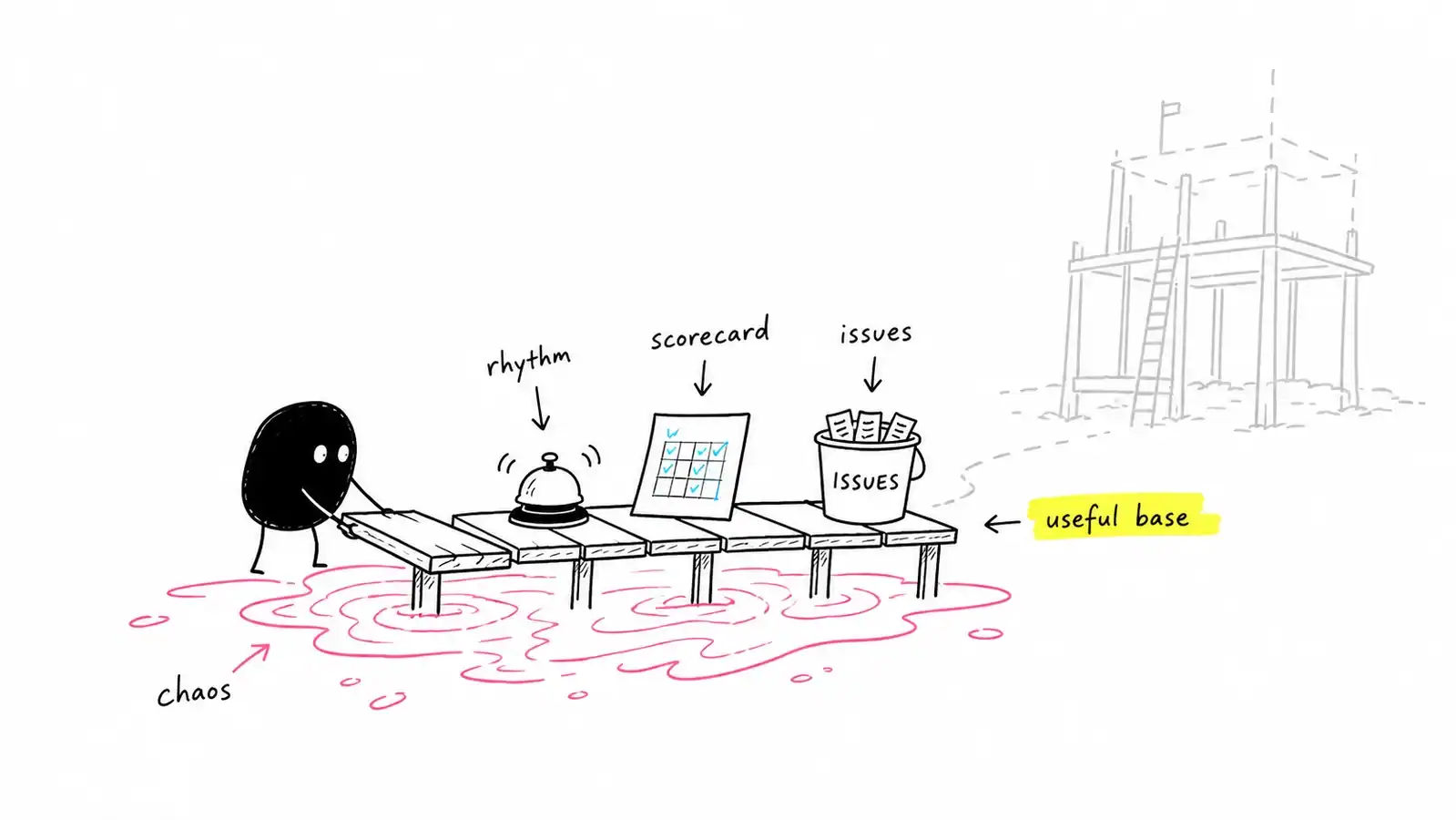
At 25 people, the pain is usually chaos. Nobody knows who owns what. You are still making too many decisions. The meeting rhythm is weak. Process lives in people’s heads. EOS can be useful because it reduces noise quickly.
At 100 people, the pain is different. You may have a leadership team, but the team does not yet lead the business without you in the middle. The strategy may be clear in your head, but not in the organisation. Growth may be eating cash through hiring, working capital, discounting, churn and operational drag.
At that stage, tidier meetings are not enough. You need a BOS that can carry the company without you holding the whole thing together.
EOS vs Scaling Up at a glance
The comparison below is for you if the company is growing, but every important decision still seems to find its way back to your desk.
| Question | EOS | Scaling Up |
|---|---|---|
| Core model | Six components: vision, people, data, issues, process and traction. | Four decisions: people, strategy, execution and cash. |
| Best fit | Companies that need simple operating discipline and leadership-team alignment. | Scale-ups that need an integrated system for strategy, leadership, execution and cash. |
| Main strength | Clear language, easy adoption, strong meeting and issue-solving cadence. | More complete scale-up architecture, especially around strategy and cash. |
| Main risk | Can become too execution-heavy if the real problem is strategic. | Can feel heavy if the business only needs basic rhythm and accountability. |
| Founder question | Can we get the leadership team aligned and accountable? | Can the business scale beyond the founder without breaking strategy, cash or culture? |
| Upgrade path | Useful operating base: Level 10, KPIs, issue-solving and accountability. | Keep the useful mechanics, add daily huddles, replace Rocks with OKRs, turn vision into OPSP, then manage strategy and cash properly. |
EOS vs Scaling Up: the specifics side by side
If you want the factual comparison rather than the diagnostic one, here’s how the two systems line up.
| Specifics | EOS | Scaling Up |
|---|---|---|
| Creator and origin | Gino Wickman, from Traction (2007) | Verne Harnish, from Mastering the Rockefeller Habits (2002) and Scaling Up (2014) |
| Best-fit size | Roughly 10 to 250 employees | Founder-led firms scaling through 30 to 250 and beyond |
| Core model | Six components: vision, people, data, issues, process, traction | Four decisions: people, strategy, execution, cash |
| Planning document | Vision/Traction Organiser (V/TO) | One-Page Strategic Plan (OPSP), plus the 7 Strata of strategy |
| Goal framework | Rocks: three to seven quarterly priorities | Priorities with KPIs and themes, often run as OKRs |
| Meeting rhythm | Weekly Level 10 meeting | Daily huddle, plus weekly, monthly, quarterly and annual |
| People framework | GWC and core values, scored with the People Analyzer | Topgrading and A-player hiring |
| Cash discipline | Light | One of the four decisions |
| Software | EOS One, or Ninety.io | Scaling Up Scoreboard, Align or Rhythm |
| Who delivers it | Professional EOS Implementers | Scaling Up Certified Coaches |
When is EOS the better choice?
EOS is often the right answer when you need simplicity more than sophistication.
If you have never run a serious weekly leadership meeting, never agreed quarterly priorities, never documented core processes and never named who owns which seat, EOS will feel like oxygen.
It gives you a common language. Rocks. Scorecards. IDS. Level 10 meetings. The Vision/Traction Organizer. The Accountability Chart.
Do not sneer at simple tools. A lot of businesses do not need a more complicated framework. They need to stop tolerating half-ownership, vague conversations and the quiet nonsense that passes for accountability.
EOS works particularly well when the leadership team is willing to accept a prescriptive rhythm. That is its strength. You are not designing an operating system from scratch. You are installing one. For a founder who has been making it up for years, that can be a relief.
But there is a tradeoff. The more prescriptive the system, the more likely it is to treat different strategic problems as if they need the same operating answer.
If your problem is basic execution discipline, fine. If your problem is that the business has no distinctive strategy, weak cash conversion, a talent ceiling and a founder who is still the constraint, EOS may not go far enough.
When is Scaling Up the better choice?
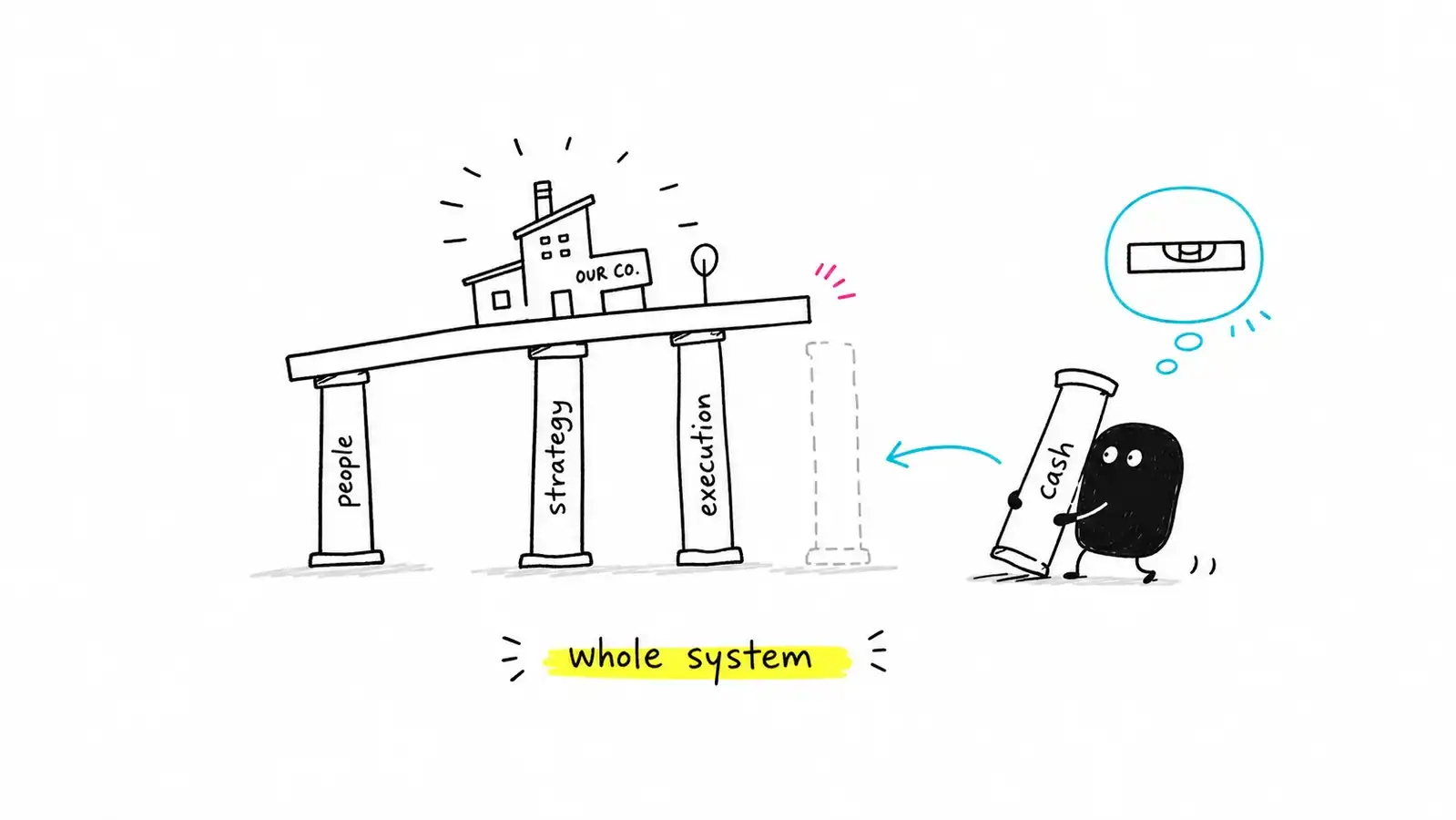
Scaling Up is the better choice when you have moved beyond basic chaos and into scale-up complexity. The four decisions, people, strategy, execution and cash, force you to work on the whole system rather than polishing the meeting rhythm.
I have a bias here. I am a Scaling Up Certified Coach and Monkhouse & Company works with businesses around the 30 to 250 employee transition. Shallow systems get found out there.
Dominic Monkhouse has lived this stage. He scaled Rackspace UK from 4 to 150 people and Peer 1 UK from 0 to 120, taking both to a £30m ARR. That is the point of this comparison: the system has to help your business make better decisions without dragging you into every room.
Harvard Business Review’s The Founder’s Dilemma makes the same point: scaling is not just a product or market problem. It is whether the founder can build a system that lets the company grow beyond their control.
You can run tidy meetings and still scale into mediocrity.
You can have weekly scorecards and still have the wrong people in the wrong seats.
You can set quarterly priorities and still run out of cash because growth has eaten the balance sheet.
You can document processes and still lose the market because your strategy is not sharp enough.
That is why the four decisions matter. They stop you treating execution as the whole game.
In founder-led companies, the strategic piece is often trapped in one skull. Yours.
You can feel the market. You can smell a bad customer. You know which opportunities are real and which are vanity. But if that judgement stays inside your head, the company has not scaled. It has just learned to wait for you.
Scaling Up gives you a way to get that thinking out of your head and into the business. The One-Page Strategic Plan, 7 Strata work, meeting rhythm, cash tools and accountability disciplines all support that shift.
That is not admin. That is founder de-risking.
For example, you may know exactly which customers damage the business, which product promises create support drag and which sales discounts look clever but destroy cash. Scaling Up turns that judgement into explicit choices the leadership team can use without waiting for you to adjudicate every tradeoff.
I scaled two companies to £30m. Every week, I'll show you how.


Which framework should you choose?
Use the symptoms in your business rather than the logos on the frameworks.
| If this is true | Choose this route | Why |
|---|---|---|
| The leadership team does not have a consistent weekly rhythm. | EOS or light rhythm | The company needs basic discipline before deeper strategic work will stick. |
| Everyone can name the priorities, but the business still feels stuck. | Move towards Scaling Up | The problem is probably strategy, people, cash or founder dependency, not meeting hygiene. |
| You already use EOS and the cadence works. | Upgrade rather than restart | Keep Level 10 and KPIs, then add daily huddles, OKRs, OPSP, strategy and cash management. |
| Growth is making cash tighter, not easier. | Use Scaling Up | Cash has to be designed into the operating system, not reported after the damage is done. |
| The founder is still the answer to every hard question. | Use Scaling Up as the architecture | The system has to reduce founder dependency, not organise it more neatly. |
| You have no operating system at all. | Install a base in one quarter | Speed matters. You need enough rhythm to start scaling before you need every advanced tool. |
What do critics get wrong about EOS?
The strongest criticism of EOS is also its strongest selling point: it is simple. That is not a flaw if simplicity is what your business needs. It becomes a flaw only when you pretend simplicity is enough for every stage of growth.
You may dismiss EOS because it feels too basic. I think that is lazy. Plenty of leadership teams would be transformed by doing the basics properly for twelve months.
The sharper criticism is that EOS can make execution look like the whole answer. If you are not careful, you get better at running the current model without asking whether the current model deserves to win.
That is dangerous at scale.
At 50 employees, you can survive a fuzzy strategy if the founder is close enough to every major decision. At 150 employees, the fuzziness spreads. Sales sells whatever it can. Product builds what shouts loudest. Finance becomes a brake rather than a design constraint. People decisions lag behind the stage of the business.
By the time you notice, you are not running a company. You are refereeing competing interpretations.
EOS can help expose that. Scaling Up is usually better equipped to rebuild it.
That is why I do not see EOS as the enemy. In many cases, EOS gives us a head start. A company with a meeting rhythm, scorecards and some accountability already installed is easier to accelerate than a company starting from nothing. The system is not the problem. The ceiling of the system is the problem.
What do critics get wrong about Scaling Up?
The lazy criticism of Scaling Up is that it is complex. Fair enough. Scaling a company is complex. The framework is trying to keep the complexity visible rather than hiding it behind neat language.
The real risk with Scaling Up is not complexity. It is weak implementation dressed up as strategy.
If you treat the One-Page Strategic Plan as a form to complete, it becomes wallpaper. If you run the meeting rhythm without real accountability, it becomes box-ticking. If you talk about cash but do not change pricing, working capital, hiring discipline or customer quality, nothing changes.
Scaling Up asks more of the founder and leadership team. That is why I like it for scale-ups and dislike it for companies that only want an easier meeting format.
If you are not willing to confront strategy, people and cash, do not pretend you are installing Scaling Up. You are doing a workshop. There is a difference.
How to upgrade from EOS to Scaling Up in 90 days
If you already run EOS, don’t start by ripping it out. That is just expensive churn. Start by deciding what to keep, what to translate and what to add.
Days 1 to 30: keep the rhythm and find the ceiling
Keep Level 10 meetings where they are useful. Keep the KPIs that genuinely show whether the business is healthy. Keep issue-solving discipline.
Then diagnose the ceiling:
- Is the leadership team aligned or merely compliant?
- Are Rocks producing outcomes or just activity?
- Does the founder still approve the decisions that should sit elsewhere?
- Is cash getting better as the business grows, or worse?
- Can the strategy be explained without the founder in the room?
This month is not about more tools. It is about telling the truth, which is usually the bit everyone has been avoiding.
Days 31 to 60: translate the operating system
Turn the useful EOS language into scale-up architecture.
Rocks become OKRs, so the quarterly work connects to measurable outcomes. The Vision/Traction conversation becomes an OPSP, so the strategy can sit on one page and guide tradeoffs. The scorecard becomes a more complete operating dashboard. The weekly rhythm stays, but daily huddles are added where the business needs faster flow.
This is where your leadership team has to stop managing tasks and start owning outcomes.
For example, a Rock such as “improve customer onboarding” is too soft if nobody can see the measurable result. An OKR forces the team to define the outcome, such as reducing time to value, increasing activation, improving gross margin or cutting support escalations.
Days 61 to 90: add strategy and cash discipline
The final step is to add the two areas that are usually too light in EOS-led businesses: strategy and cash.
Strategy means making choices. Which customer will you over-serve? Where will you be meaningfully different? What will you stop doing? What is the one word or phrase the market should associate with you?
Cash means designing growth so it can fund itself. Pricing, collections, gross margin, working capital, hiring pace and customer quality all belong in the operating conversation.
By day 90, the aim is not to have a prettier planning document. The aim is to have a business that makes better decisions without you holding the whole thing together.
Can you combine EOS and Scaling Up?
You can borrow tools from both, but you should not run two operating systems at once. That is how you create language clutter and accountability fog.
You may say, “We like EOS meetings, but we like the Scaling Up strategy tools.” Fine. Use what works. But someone has to own the architecture. Otherwise your leadership team ends up with Rocks, quarterly priorities, scorecards, OPSPs, V/TOs, issue lists, dashboards and no clear operating spine.
Do not mistake more tools for more discipline.
The better route is to choose a primary system, then adapt carefully. If EOS is your base, be honest about where strategy and cash need extra work. If Scaling Up is your base, be disciplined about simplicity and rhythm so it does not become an annual planning exercise with better branding.
The operating system should reduce founder dependency. If it adds meetings, documents and jargon while every difficult decision still lands on your desk, it has failed.
For companies with no operating system at all, the pragmatic move is to install a base rhythm quickly. Monkhouse & Company already runs Scaling Up programme formats with online calls, expert webinars, momentum calls and quarterly intensives. The aim is to get enough structure, language and cadence in place within a quarter, then deepen the Scaling Up work that makes the business genuinely less founder-dependent.
We built that route because starting from nothing is a different problem from upgrading a system that already exists. The fastest progress usually comes from installing the minimum viable rhythm first, then using the next layer of work to sharpen strategy, cash and leadership capacity.
Which framework is better for a 30 to 250 employee founder-led company?
For a founder-led company moving from 30 to 250 employees, Scaling Up is usually the better fit. That is the stage where your old BOS starts to punish you for past success.
Founder Ceiling is simple: company can’t grow past what founder won’t let go of. It is one reason operating rhythm matters as you move through the 30 to 250 employee stage. See Monkhouse & Company’s guide to operating rhythm for the broader cadence behind this work.
At 20 people, you can be the best player on the pitch and still win. At 100 people, that becomes the problem. You have to get off the field. You have to build a leadership team that owns outcomes, not tasks. You have to turn instinct into a system without killing the entrepreneurial edge that made the company work in the first place.
That is the basketball-to-football shift.
EOS can help with the first version of that move. It can clarify roles, meetings and priorities. But Scaling Up is stronger when the question becomes: what is the system that lets this business scale without making the founder the hero every week?
That question includes cash. You may be allergic to this bit because revenue growth feels like proof. It is not. Growth can make a weak business weaker. Hiring ahead, slower collections, discounting, support drag and management layers can burn cash while the top line looks impressive.
Scaling Up keeps cash inside the operating conversation. Not as a finance report at the end. As one of the four decisions.
How should you choose?
Choose EOS if your business is mostly suffering from loose alignment, weak accountability and inconsistent meeting rhythm.
Choose Scaling Up if the pain is bigger: weak strategic clarity, cash pressure, leadership-team capability gaps, founder dependency and the need to build a company that can run without you.
Here is the practical test.
- If the leadership team cannot name the priorities for the quarter, start with operating discipline.
- If everyone can name the priorities but the company still feels stuck, look at strategy, people and cash.
- If the founder is still the answer to every hard question, the operating system is not yet doing its job.
- If growth is increasing complexity faster than leadership capacity, choose the system that builds capacity, not just meeting discipline.
The decision is not philosophical. It is diagnostic.
What ceiling have you hit?
What does EOS or Scaling Up cost in the UK?
Cost depends almost entirely on one choice: do it yourself, or bring in a coach.
On the do-it-yourself end, both systems are cheap. EOS runs from Traction by Gino Wickman, a paperback for around £15. Scaling Up runs from Scaling Up by Verne Harnish, around £16, and most Scaling Up coaches will run a free 4 Decisions assessment to show you where you stand.
Coach-led is where the numbers climb, and the two systems price differently.
- EOS. Professional EOS Implementers set their own fees. EOS Worldwide says most implementers charge between $3,000 and $5,000 per session, with leadership teams completing around ten sessions over two years, rising to $10,000 a session at the most experienced level.
- Scaling Up. Verne Harnish sets out four cost tiers: the book, public workshops at $295 to $495 per executive, the online Master Course at roughly $2,000 per executive, and full private coaching that can run from tens of thousands to $200,000 a year for larger firms.
The number that matters is not the day rate. It is what fixing this is worth to you.
Here is how I price it with clients. One of our early promises is to get you a day a week back inside the first 90 days. The knowledge was never the problem. Everyone knows how to get fit; life gets in the way. Same with EOS or Scaling Up: founders don’t implement because they’re stuck in the middle of the business, being the bottleneck. So we start by getting the day back.
Then I ask what that day is worth. In a recent session, one founder did the maths out loud: a day a week back was worth £2m of ARR he could add over the next four months, no doubt about it. At that point the day rate is irrelevant. We work to a 10x return on the engagement, the client runs their own numbers, and in my experience they beat it. My fee, which starts at £3,000 a month, goes in at the bottom of that sum, not the top.
EOS and Scaling Up implementers and coaches in the UK: who does what
If you have decided which system you want, the next question is who delivers it. The two systems have separate delivery networks, and it helps to know which camp a provider sits in before you call them.
One honest note first. Monkhouse & Company is a Scaling Up coaching firm. We’re not EOS implementers and we don’t install EOS. If EOS is what you want installed by the book, the providers in the first group are the right call.
| Provider | System | Best for |
|---|---|---|
| EOS Worldwide / Professional EOS Implementers | EOS (Traction) | Installing EOS by the book. Find one through the official EOS Implementer directory. |
| Scaling Up Certified Coaches | Scaling Up | The broader people, strategy, execution and cash system. Find one through the Scaling Up coach directory. |
| Monkhouse & Company | Scaling Up | Founder-led UK firms of 30 to 250 people (£3m to £50m) who have outgrown EOS. |
Why EOS and Scaling Up coaches work differently
Both systems are good. Any methodology beats none. But there is a difference that never shows up in the comparison tables: how the two sets of coaches are allowed to work.
EOS runs on a franchise model. EOS Worldwide was acquired by private investment firm Firefly, with founders Gino Wickman and Don Tinney keeping a stake, and its implementers pay a monthly franchise fee to deliver the system. The brand is built on running the pure EOS process. EOS Worldwide’s own advice is to pick one system and commit to it fully, and not to mix. That consistency is part of the appeal. It also means your EOS coach works from one fixed toolbox.
Scaling Up is a network, not a franchise. You get certified in the framework, then you’re free to bring whatever tool gets the client the right outcome.
That difference is why I never got EOS-certified. When I looked at it years ago, the restriction was the dealbreaker. I might have a client with a problem the EOS toolbox isn’t quite right for, and I didn’t want to paint the same picture by numbers every time. So instead I get certified on a new tool most years, six evidence-based methodologies and counting, and Monkhouse & Company has spent over a decade helping more than 200 founder-CEOs using Scaling Up tools, some EOS tools, and whatever else fits the job.
Here is what that looks like in practice. For one leadership team, Patrick Lencioni’s Five Dysfunctions of a Team is exactly the right tool. For another it’s exactly the wrong one, and you have to start with the six conditions of a high-performing team and do the structural work before you go anywhere near the fake harmony. Same problem on paper. Different tool. You only get to make that call if you’re allowed to carry more than one tool.
The right tool for the right problem for the right client. EOS, by design, doesn’t allow it. Scaling Up does, and that’s why it suits me.
My view
Monkhouse & Company’s view, in one line: for a founder-led UK business past roughly 50 people, choose Scaling Up over EOS, keep the EOS habits that still work, and upgrade the ceiling rather than reinstalling from scratch.
Not because EOS is weak. Because your problem is probably bigger than alignment.
Status quo bias is the trap here. The current BOS feels safe because it is familiar. But if the familiar system keeps dragging you back into every hard decision, it is not safe. It is expensive.
You need a leadership team that can lead. You need a strategy that can be explained without you in the room. You need cash discipline that does not disappear every time growth accelerates. You need a meeting rhythm that exposes reality rather than decorating it.
And you need to stop being the operating system yourself.
That is the bit you can miss. You ask whether to install EOS or Scaling Up as if the business is a machine waiting for new software. But the real operating system is usually you. Your instincts. Your bottlenecks. Your approvals. Your avoidance patterns. Your private version of the strategy.
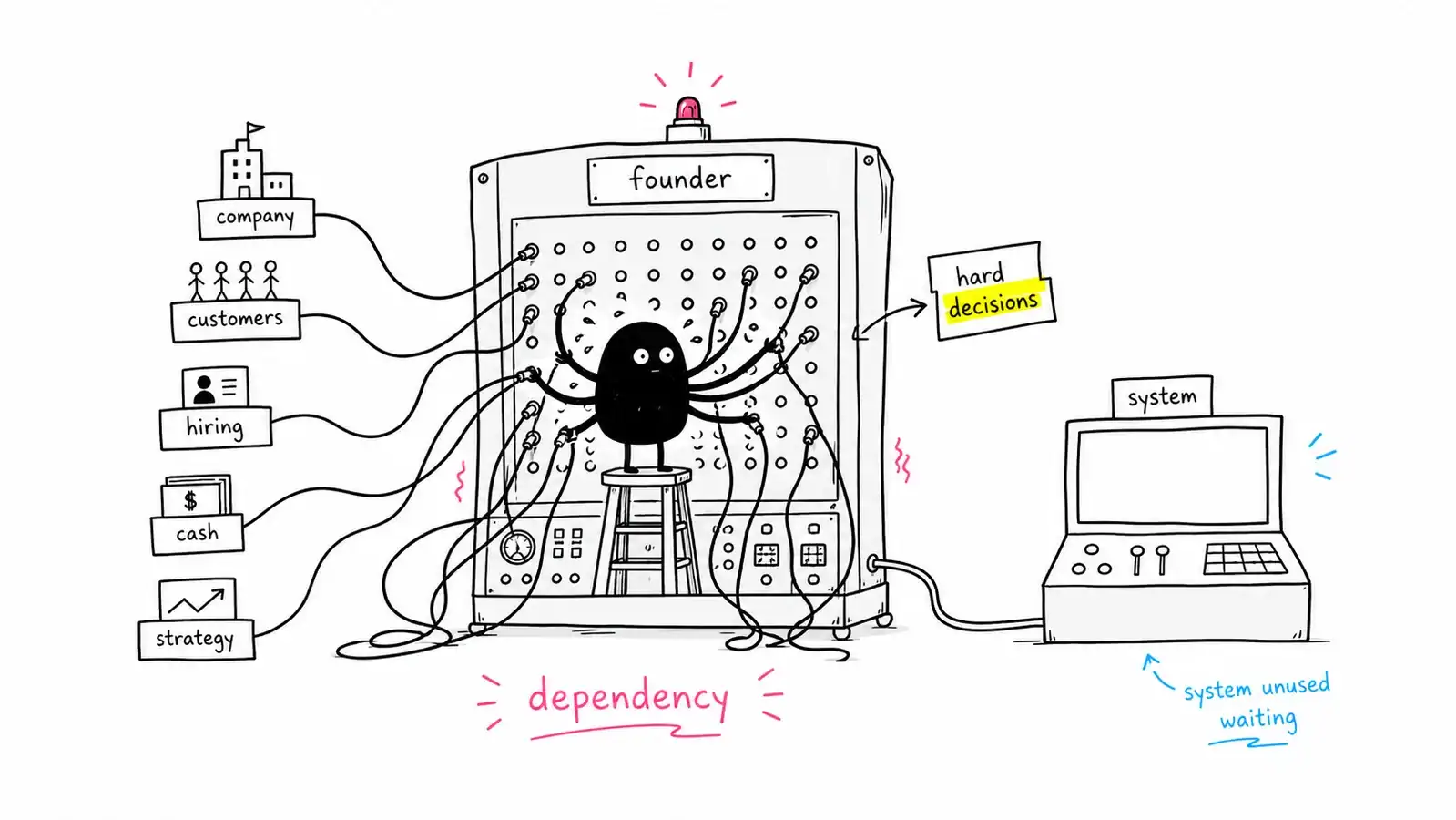
Until that changes, no framework saves you.
EOS can help you get a grip.
Scaling Up can help you build a company that does not need your grip on everything.
Choose accordingly. Then have the guts to let the system do its job.
FAQs
Is EOS the same as Scaling Up?
No. EOS is built around six components: vision, people, data, issues, process and traction. Scaling Up is built around four decisions: people, strategy, execution and cash. They overlap on accountability, meetings and priorities, but they are not the same operating system.
Is Scaling Up better than EOS?
Scaling Up is not universally better than EOS. It is usually better for larger or more complex scale-ups because it gives more weight to strategy and cash. EOS can be better for businesses that need a simpler, more prescriptive way to get aligned and accountable.
What size company is EOS best for?
EOS is often useful for entrepreneurial companies that need simple structure, clearer ownership, better meetings and sharper quarterly execution. It can work at different sizes, but its simplicity is most valuable when the main problem is operating discipline rather than strategic complexity.
What size company is Scaling Up best for?
Scaling Up is a strong fit for companies moving through scale-up complexity, especially founder-led firms approaching or beyond 50 people. It is particularly useful when the business needs to strengthen strategy, leadership capacity, execution and cash at the same time.
Can a company use EOS first and then move to Scaling Up?
Yes. A company can use EOS to create basic rhythm and accountability, then move towards Scaling Up when strategy, cash and leadership-team capacity become the bigger constraints. The practical upgrade is to keep the useful habits and replace the parts that now constrain scale.
What are the alternatives to EOS for a growing UK business?
The main alternatives are self-implementing EOS from Traction, keeping EOS but upgrading it with OKRs, an OPSP, daily huddles and cash management, or moving to a broader system such as Scaling Up. For a founder-led firm past roughly 50 people, Scaling Up is usually the stronger fit because it treats strategy and cash as core decisions, not add-ons.
Are there Traction or EOS coaches in the UK?
Yes. EOS, the system from Traction, is delivered by Professional EOS Implementers, and you can find UK ones through the official EOS Implementer directory. If you have outgrown EOS, the alternative is a Scaling Up Certified Coach who works on the broader people, strategy, execution and cash system. Monkhouse & Company is a Scaling Up coaching firm, not an EOS implementer.
Is there an alternative to hiring an EOS implementer?
Yes. You can self-implement EOS straight from Traction with no implementer, which works when the constraint is basic operating discipline. Or, if the business has outgrown simple rhythm and the real issues are strategy, cash and founder dependency, the alternative is to move to Scaling Up with a certified coach rather than installing EOS at all.
How much does EOS or Scaling Up cost in the UK?
Both are cheap to self-implement: the books cost around £15 to £16. Coach-led, EOS Worldwide says most EOS Implementers charge $3,000 to $5,000 per session across around ten sessions over two years. Scaling Up ranges from public workshops at $295 to $495 per executive, to an online Master Course at roughly $2,000 per executive, up to full private coaching that can reach $200,000 a year for larger firms. The bigger cost to weigh is the price of staying founder-dependent while you decide.
What should you do next?
If this comparison has made you slightly uncomfortable, good. That usually means you are not choosing between two frameworks. You are looking at the fact that your current BOS has stopped scaling.
Monkhouse & Company works with founder-led UK businesses of 30 to 250 people (£3m to £50m) who have outgrown EOS and want to install Scaling Up properly. That’s the whole job: getting you out of the middle so the business can scale without you in every decision. If that’s you, that’s exactly what our founder coaching is built for.
The next move is not to buy another planning tool. It is to decide whether the business needs basic operating discipline or a fuller architecture for people, strategy, execution and cash.
That is the point. A BOS should reduce founder dependency. If it organises the dependency more neatly, it has failed.
Four ways to take this further
- Book a call. If your current BOS is now constraining growth, Dominic can help you decide whether the problem is rhythm, strategy, cash, leadership capacity or founder dependency. No obligation, no pitch. You will know quickly whether this is the right kind of help.
- Grab the book. Mind Your F**king Business gives founder-CEOs a practical way to stop being the bottleneck and build a company that can scale without them in every room.
- Read the Scaling Up guide. Start there if you want the broader view of how Scaling Up works as a business operating system.
- Subscribe to the newsletter. One practical scale-up idea each week for founder-CEOs building a company that can run without them being dragged into every room.
Your move. Stop asking which framework is nicer. Ask which BOS will force you to stop being the one holding the business together.
About the author
Dominic Monkhouse scaled Rackspace UK from 4 to 150 people and Peer 1 UK from 0 to 120, taking both to a £30m ARR. He is the founder of Monkhouse & Company and has coached more than 200 founder-CEOs through scaling.